HelioChronicles: Mapping the Sun’s History | Parker’s Physics Engine
Yesterday I began a new project called the HelioChronicles to track space weather data back through history.
It is open source, free, and easily accessed by anyone for any reason. I wanted to create an outside reference for the data Parkers Physics machine learning models will used for prediction and historical analysis, so feel free to use it for anything that you want.
Building a Living Timeline of Solar Activity for Parker’s Physics
The Sun is not static. It is a living system—violent, cyclical, and constantly evolving.
Yet most tools treat it like a snapshot.
That’s the gap HelioChronicles is designed to solve.
👉 Project: https://github.com/etelford32/heliochronicles
This is more than a dataset or visualization. It’s the beginning of a historical engine for the Sun, designed to power the next generation of real-time space weather applications—starting with Parker’s Physics.
The Problem: We Don’t Think About the Sun in Time
Most people experience the Sun as now:
- Today’s solar flare
- This week’s geomagnetic storm
- Current satellite conditions
But heliophysics doesn’t work like that.
The Sun operates on cycles, memory, and long-term patterns:
- ~11-year solar cycles of activity
- Magnetic polarity reversals every cycle
- Multi-century anomalies like the Maunder Minimum
- Plasma flows and magnetic reconnection evolving continuously
The result?
👉 We are constantly reacting to solar activity, instead of understanding it.
What is HelioChronicles?
HelioChronicles is a system for reconstructing and exploring the Sun’s behavior over time.
Think of it as:
A time-aware model of solar activity—not just what the Sun is doing, but what it has done and what it’s likely to do next.
At its core, HelioChronicles aims to:
- Track historical solar cycles and transitions
- Store structured solar event timelines
- Enable pattern detection across cycles
- Feed predictive systems for space weather
This is foundational infrastructure for Parker’s Physics.
Why This Matters (More Than You Think)
Heliophysics isn’t abstract science—it directly affects civilization.
The Sun drives:
- Satellite reliability
- GPS accuracy
- Power grid stability
- Atmospheric dynamics
- Radiation exposure in space
Solar activity like flares and coronal mass ejections can disrupt entire technological systems .
And these events are not random.
They are part of a structured, cyclical system driven by magnetic field evolution.
The Missing Layer: Solar Memory
Here’s the key insight behind HelioChronicles:
The Sun has memory—but most systems don’t.
We know:
- Solar cycles repeat with variation
- Sunspot patterns evolve predictably
- Magnetic fields flip and reorganize
- Activity clusters in time and space
Yet most tools:
- Don’t track long-term context
- Don’t connect events across cycles
- Don’t build a continuous narrative
HelioChronicles introduces that missing layer:
👉 Temporal continuity
How This Connects to Parker’s Physics
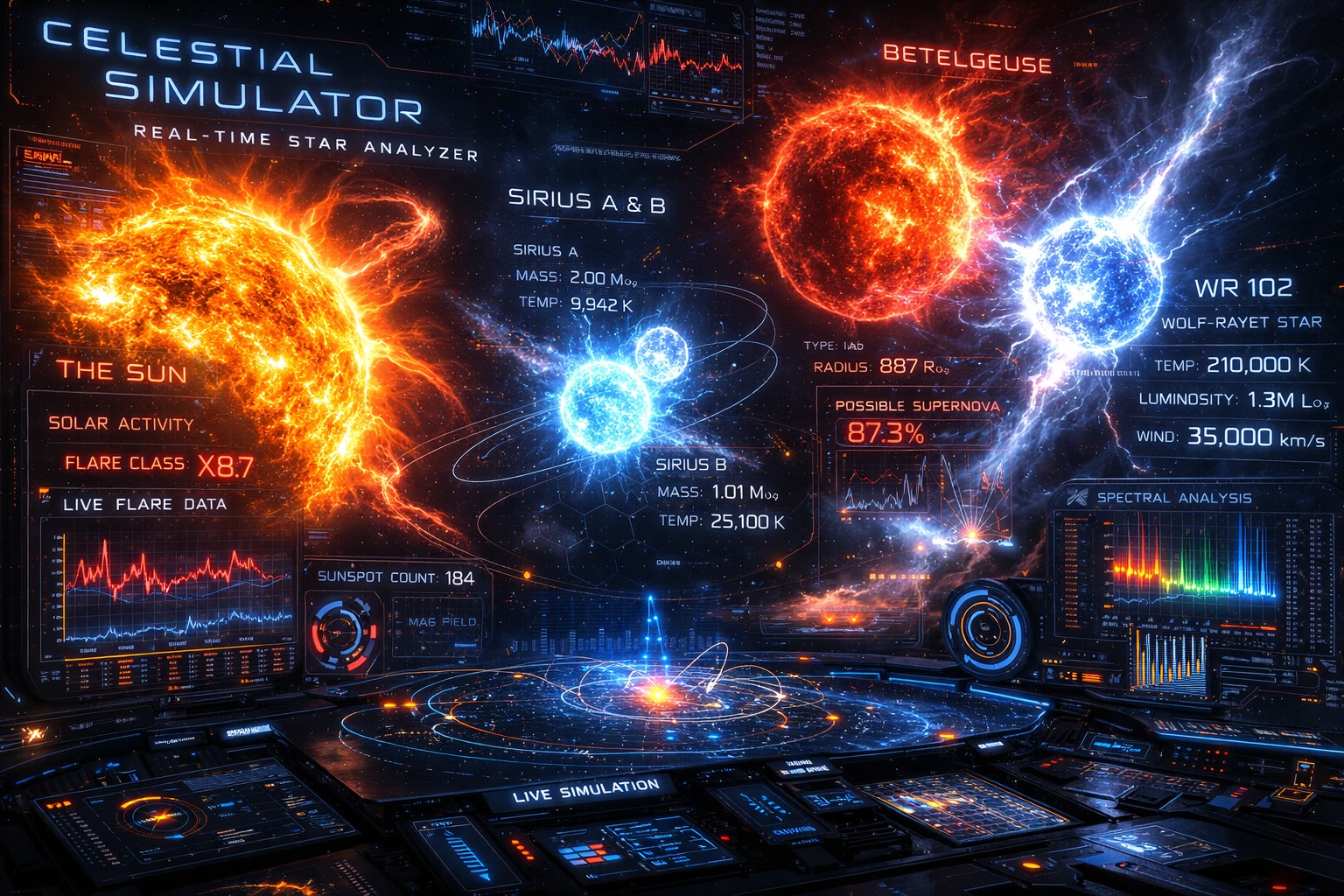
If Parker’s Physics is the interface, then HelioChronicles is the memory system behind it.
Parker’s Physics (Frontend Vision)
- Real-time solar visualization
- Space weather alerts
- Predictive modeling
- User-facing insights
HelioChronicles (Backend Engine)
- Historical solar timelines
- Event indexing + storage
- Cycle-aware modeling
- Pattern recognition
Together, they form:
A living model of the Sun–Earth system
Not just observing—but understanding.
The Bigger Vision: From Data → Simulation
This is where things get interesting.
HelioChronicles isn’t just about history.
It’s about building toward:
1. Predictive Solar Models
Using historical cycles to forecast:
- Flare probability
- CME likelihood
- Magnetic instability windows
2. Causal Chains
Linking:
- Solar emissions → space weather → Earth effects
3. Simulation Systems
Eventually enabling:
- Forward simulation of solar activity
- Scenario modeling for satellite operators
- Real-time risk scoring
Why Build This Now?
We are entering a new phase of solar activity.
Solar Cycle 25 is ramping toward peak, meaning:
- Increased flare frequency
- More geomagnetic storms
- Greater infrastructure risk
And at the same time:
- Humanity is more dependent on space-based systems than ever
- Satellite density is exploding
- Space weather prediction is still limited
This creates a clear opportunity:
Build tools that understand the Sun as a system—not a snapshot.
Where This Goes Next
HelioChronicles is an early-stage system—but it’s foundational.
Next steps could include:
- Integrating NOAA / NASA solar datasets
- Building a time-series database for solar events
- Creating cycle-aligned visualizations
- Feeding predictive models into Parker’s Physics UI
- Mapping solar events to real-world impacts
Final Thought
The Sun is not just something we observe.
It is something we are inside of.
Heliophysics shows us that Earth exists within a dynamic, plasma-driven environment shaped by solar activity.
HelioChronicles is the beginning of:
Understanding that environment as a timeline, a system, and eventually—a simulation.
Explore the System
- 🔗 GitHub: https://github.com/etelford32/heliochronicles
- 🌐 Live App: https://www.parkersphysics.com