
Sirius A and B: Observational Data
Overview of the Sirius Stellar System
The Brightest Star (not planet) in the sky. Sirius is a wonderful reminder of how exotic the universe is.
Sirius A is about 240 Million years old.
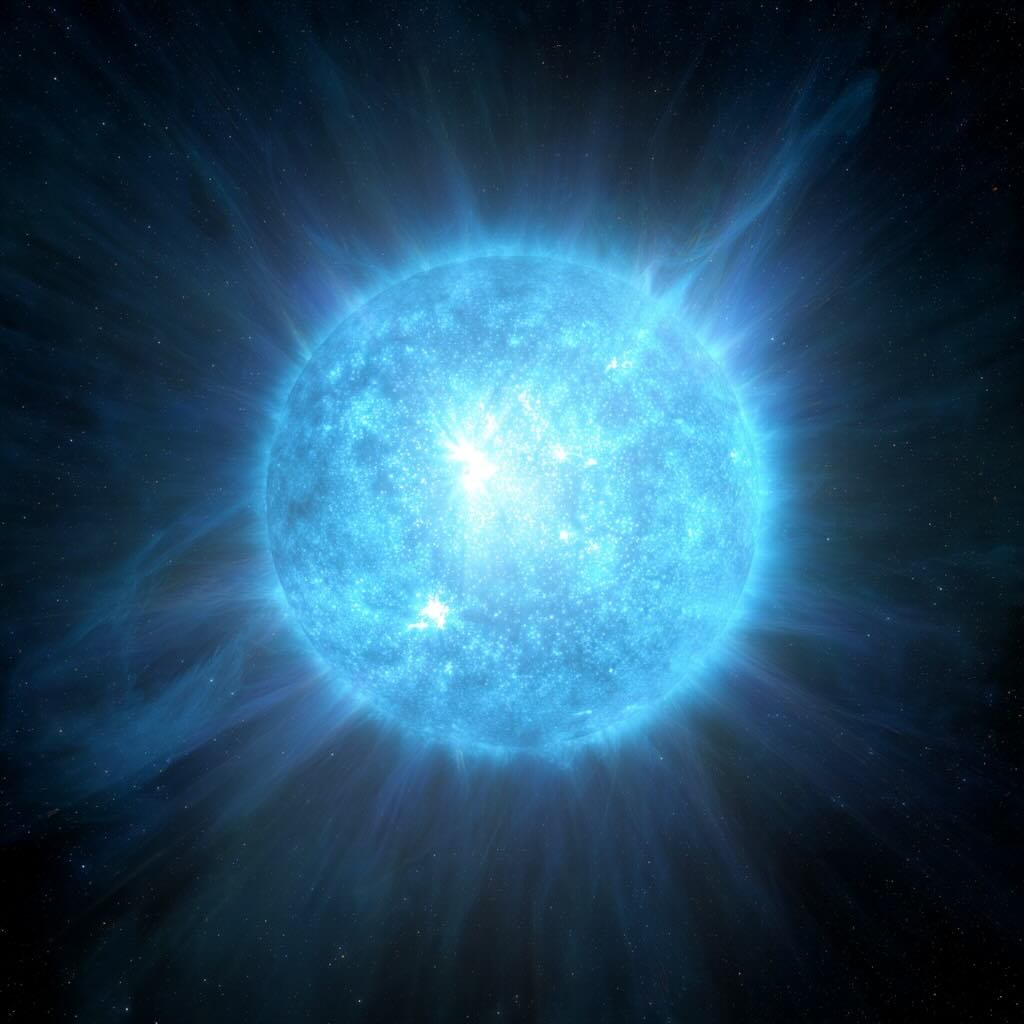
Sirius (Alpha Canis Majoris) is the brightest star in Earth’s night sky, with Sirius A – a main-sequence blue-white star (apparent visual magnitude −1.46) outshining all others. Sirius A is twice as massive as the Sun and 25 times more luminous.
9,940 Kelvin – Sirius A apprx surface temperature
5,778 Kelvin Sun surface temperature
Sirius is gradually moving closer to the Solar System and it is expected to increase in brightness slightly over the next 60,000 years to reach a peak magnitude of −1.68.
Celestial Simulator – Sirius A & B Enhancement

Introducing the Celestial Simulator App
My new Celestial Object and stellar simulation application for astrophysics and game development. This is part of my research for Explore the Universe 2175, which comes out in just about 8 months, on 9.30! I built this application to explore star physics and rendering. Now its turning into something pretty cool!
You can visit the Celestial Sim project at my profile on Github or on the Celestial Simulator Application on Vercel. The Fluid Simulator is incredible! Make sure you give it a good look through, there are some fascinating patterns in there, especially for binary systems like Sirius A and B.
Also, please keep in mind this is experimental software! That doesn’t mean its dangerous, just that there are bugs and inaccuracies that pop-up and because I focus on development, and creating new things, I often miss details and nuances that need further exploration. Feel free to comment and critique and suggest improvements! This software is open source for a reason, it can be easily built on and expanded…. I use modular, object based code that is easy to update and maintain.

Sirius – The Dog Star
Σείριος (Latin script: Seirios; lit. ’glowing’ or ‘scorching’)
Sirius’ name derives from the Greek word Seirios, meaning “glowing” or “scorching”. It is most visible during winter in the Northern Hemisphere and in ancient times the star’s presence in the sky signified the Dog Days of Summer. The term refers to the period when Sirius rises and sets with the Sun, which ancient Greeks and Egyptians associated with the hottest part of the summer.
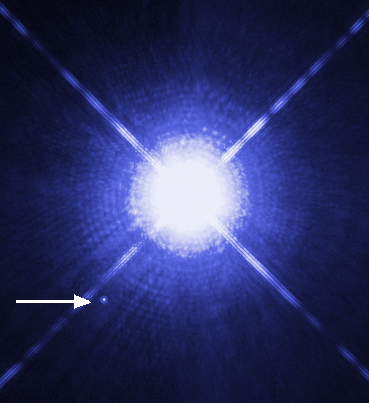
Sirius is a binary star system consisting of a luminous A-type main-sequence star (Sirius A) and a faint white dwarf companion (Sirius B) . The two stars orbit each other every 50 years, with their separation ranging from about 8.2 AU to 31.5 AU over the course of the orbit . At a distance of roughly 2.64 parsecs (~8.6 light-years) from Earth, Sirius is one of our nearest stellar neighbors . Figure 1 below shows an actual Hubble Space Telescope image of the Sirius system, with blinding Sirius A at center and tiny Sirius B visible nearby.
Figure 1: Hubble Space Telescope image of Sirius A (center, saturated to bring out the companion) and its tiny companion Sirius B (lower left). Sirius A’s diffraction spikes and rings are imaging artifacts. The white dwarf Sirius B is about 10,000 times fainter than Sirius A in visible light . Using Hubble’s spectrograph to isolate Sirius B’s light, astronomers measured the gravitational redshift in its spectrum, confirming Sirius B’s mass is ~0.98 M☉ (about 98% of the Sun’s mass) and refining its surface temperature to ~25,000 K .
Spectral Characteristics
Sirius A (Primary): Sirius A is classified as a hot A-type star, traditionally A1 V in the Morgan–Keenan system (sometimes noted as A0 or A1 V with enhanced metal lines). High-resolution spectra reveal that Sirius A is a metallic-line star (Am) with heavy elements (like iron) overabundant by factors of 10–100 relative to solar . Its spectral type is often given as A0mA1 Va, indicating an A1-type hydrogen spectrum but stronger metal lines typical of an Am star . The star’s hydrogen Balmer absorption lines are prominent (as expected for an A1V star), and the overabundant metals produce marked absorption features in the spectrum . Sirius A rotates relatively slowly – v sin i ≈ 16 km/s – which likely helps gravity-driven chemical stratification (levitation of certain metals) in its atmosphere .
In terms of its spectral energy distribution (SED), Sirius A’s ~10,000 K effective temperature means its emission peaks in the near-UV to visible range (Wien’s law peak around ~290 nm). Sirius A’s flux has been empirically calibrated from the ultraviolet to infrared. Hubble/STIS measurements from 0.17–1.01 μm agree with model atmospheres, confirming Sirius A as a reliable flux standard across the spectrum . (In fact, Sirius A is often used as a primary IR flux calibration star because Vega’s IR output is complicated by a debris disk .) Sirius B’s contribution to the combined SED is negligible in visible light, but in the far ultraviolet (~130 nm) the white dwarf contributes on the order of 1% of the system’s flux due to its high temperature . Overall, Sirius A’s color indices are nearly zero (B–V ≈ +0.00, U–B ≈ −0.05) , consistent with a white-blue A-type star.
Sirius B (Companion): Sirius B is a white dwarf of spectral type DA2 . The “DA” classification denotes a hydrogen-dominated atmosphere (showing strong broad hydrogen Balmer absorption lines), and the numeral “2” indicates an effective temperature on the order of 25,000 K. Indeed, Sirius B’s surface temperature is approximately 25,000 K . Its spectrum was famously found to resemble that of Sirius A (an A-type star) despite its faintness , which historically led to the recognition of white dwarfs as a distinct class of low-luminosity, blue-white stars. With such a high temperature and surface gravity (log g ≈ 8.57 cgs) , Sirius B’s spectral lines are extremely broadened by pressure (Stark broadening in its dense atmosphere). The white dwarf emits strongly in the ultraviolet and soft X-rays. (For example, observations have shown Sirius B as a bright soft X-ray source, whereas Sirius A is much cooler and dim in X-rays by comparison .) Visually, Sirius B has an apparent magnitude of +8.44 in V-band – 10 magnitudes fainter than Sirius A – and is essentially invisible to the naked eye next to the dazzling primary.
Photometric Stability: Sirius A is not known to be significantly variable in brightness; it has shown no intrinsic variability above the millimag level in precise photometry. Long-term, however, the system’s apparent brightness is slowly increasing as Sirius moves slightly closer to our Solar System. Owing to its space motion, Sirius will brighten to magnitude –1.68 over the next ~60,000 years (after which it will eventually recede and fade). Historical records (e.g. ancient descriptions of Sirius as red) remain controversial and are likely due to atmospheric effects or transcription errors rather than actual variability.
Magneto-HydroDynamic Fluid Simulation of Sirius A & B
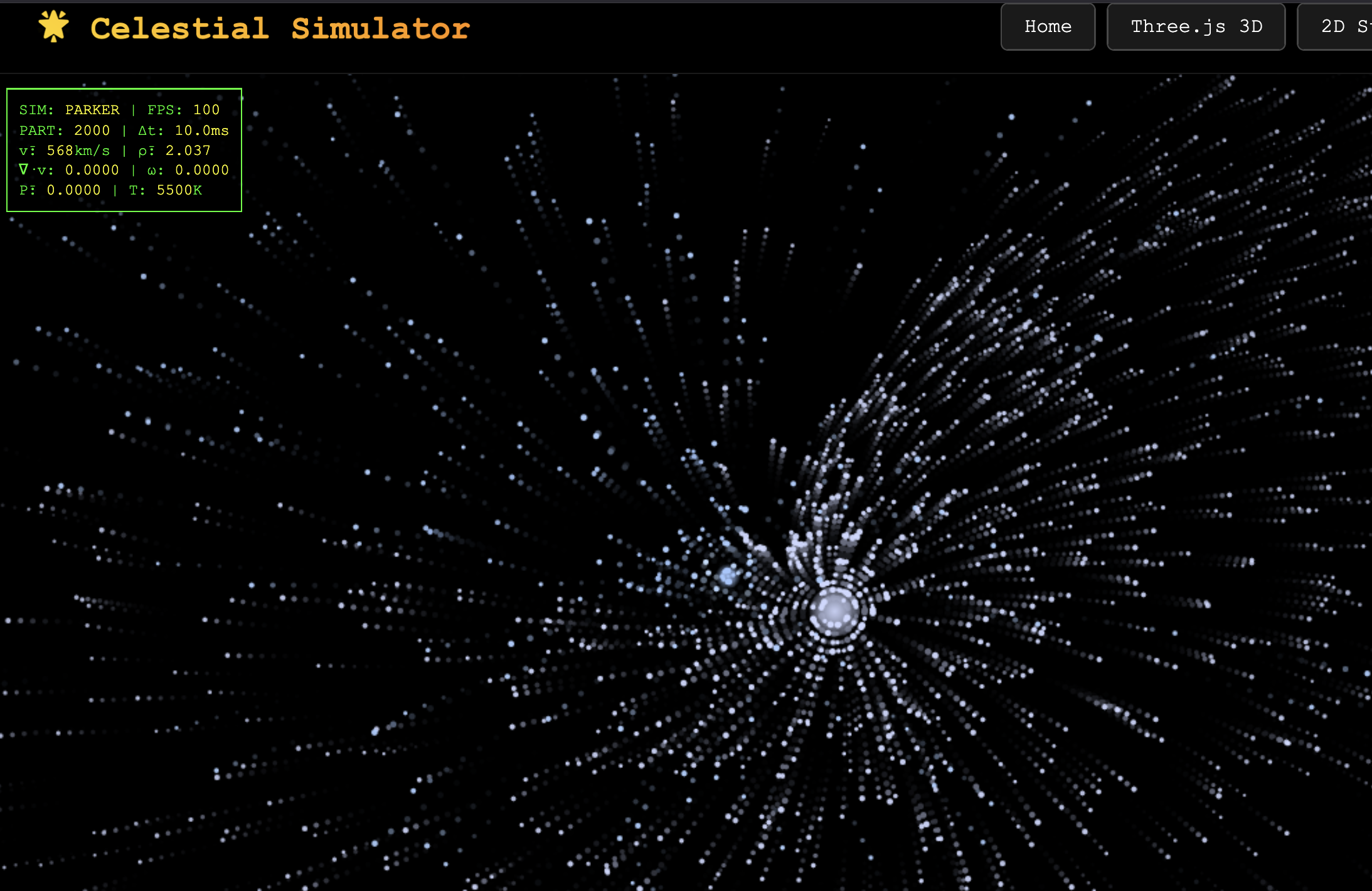
In the Celestial Simulator that I am building for Explore the Universe, I have spent a bit of time developing a fluid dynamics simulation for stellar emissions. The idea is to try to simulate parker spirals and gravity fields together, which is high approximate and not really accurate in terms of the numerical outputs of the application as it is still mostly a visual simulation engine; however, we can gain an intuition of the potential behaviors of these kinds of systems. Adjusting the parameters to see how the functions interact and fine tuning the simulation is pretty interesting… be careful with the *trails* in the fluid simulation, unless you have some GPU power it will probably slow things down a lot.
Adjust the parameters of the simulation to see how they might interact on a larger scale; the physics scales and the visuals stay fairly cohesive between the simulations, but I am working on shader code for the three.js simulations and optimizing pygame visuals for stars in the others. For the Explore the Universe game engine, to be more specific.
Radial Velocity and Proper Motion (Kinematics)
Radial Velocity: The systemic radial velocity of the Sirius binary is about −5.5 km/s (approaching the Sun) . This is the line-of-sight velocity of the center of mass. Because Sirius A and B orbit each other, each star’s individual radial velocity oscillates around this value with the orbital period. The orbital motion causes slight Doppler shifts; for example, near one side of the orbit Sirius A will be moving toward us a bit faster (bluer), and half an orbit later receding (redder). The observed radial velocity of Sirius A thus varies by a few km/s around the mean as the stars orbit . The quoted –5.5 km/s is the center-of-mass velocity, indicating the Sirius system is currently moving toward the Solar System. (This correlates with the fact that Sirius is gradually getting nearer and brightening over millennia .)
Proper Motion: Sirius exhibits a high proper motion across the sky, a reflection of its close distance. Sirius A’s proper motion is measured as μα = –546.0 mas/yr in right ascension and μδ = –1223.1 mas/yr in declination . This corresponds to a combined motion of about 1.3 arcseconds per year. In physical terms, Sirius is moving roughly perpendicular to our line of sight at about 17 km/s across the sky . This significant proper motion was first noticed by Edmund Halley and later quantified by Friedrich Bessel. It was Bessel in 1844 who detected anomalous wobbles in Sirius’s proper motion, hinting at an unseen companion (later confirmed as Sirius B) . Today, Gaia astrometry has measured Sirius A and B’s motions with extremely high precision, further refining our knowledge of their orbits and trajectory through space .
Distance and Parallax
The Sirius system’s distance has been measured via stellar parallax for over a century, and modern space-based measurements have nailed it down with high accuracy. The Hipparcos mission (new reduction) reported a parallax of π = 379.21 ± 1.58 mas for Sirius A , which corresponds to a distance of about 2.64 ± 0.01 pc (~8.60 light-years). More recently, Gaia (Early Data Release 3) was able to measure Sirius B’s astrometric solution, finding π ≈ 374.49 ± 0.23 mas – equivalent to 2.670 ± 0.002 pc (8.709 ly). These values are in excellent agreement, given the challenges of measuring a binary with such extreme brightness contrast. Adopting a distance of approximately 8.6 light-years is appropriate for modeling. This makes Sirius the fifth closest stellar system known . The slight difference between the parallax of A and B is due to orbital motion and measurement uncertainties; a combined fit yields a distance around 2.64–2.65 pc. For reference, the absolute magnitudes are MV = +1.43 for Sirius A and +11.18 for Sirius B , underscoring the huge luminosity difference between the two.
Binary Orbital Parameters
Observations of Sirius A and B over time (dating back to the 19th century) and high-precision measurements (including Hubble Space Telescope astrometry in the 2000s) have produced a well-determined set of orbital parameters . Sirius’s binary orbit is highly elliptical and oriented such that we view it at an angle (not edge-on). The key orbital parameters for the Sirius A–B system are:
- Orbital Period (P): 50.13 ± 0.0043 years
- Semi-major Axis: 7.50″ ± 0.003″ on the sky , which at 2.64 pc translates to ~20 AU in physical separation.
- Eccentricity (e): 0.5914 ± 0.0004 (quite eccentric).
- Inclination (i): ~136.3° ± 0.04° relative to our line of sight. (This inclination > 90° means the orbit is tilted such that Sirius B appears to go below the plane of Sirius A’s orbit as seen from Earth, i.e. we see the orbit somewhat from underneath.)
- Longitude of Ascending Node (Ω): ~45.4° (orientation of the orbit on the sky).
- Argument of Periastron (ω, of secondary): ~149.2° .
- Time of Periastron (T): 1994.5715 (mid-1994) was the most recent periastron passage.
These parameters indicate that Sirius B’s orbit around A (or vice versa, since both orbit their common center of mass) is an ellipse with a semi-major axis of 20 AU and a periapsis of ~8 AU (when the stars are closest) and apoapsis of ~32 AU when farthest . The orbital plane is tilted, so we do not see eclipses or transits, but we do observe the positions change significantly over the 50-year cycle. In fact, Sirius B has been observed visually to trace an apparent ellipse around Sirius A since its discovery in 1862. Ground-based observatories and HST imaging together have tracked the relative positions to very high precision . The latest orbital solution (e.g. Bond et al. 2017) yields dynamical masses for both stars by combining the orbital motion and parallax.
Physical Properties of Sirius A and B
Both components of the Sirius system are well-characterized in terms of their fundamental stellar parameters. Table 1 compares key physical properties of Sirius A and Sirius B, based on the most recent observational determinations:
| Property | Sirius A (Primary) | Sirius B (Companion) |
|---|---|---|
| Spectral Type | A1 V (hot metallic-line A-type star) | DA2 (hydrogen-atmosphere white dwarf) |
| Mass (M☉) | 2.06 ± 0.02 (about 2 × Sun) | 1.018 ± 0.011 (≈98% of Sun) |
| Radius (R☉) | 1.713 ± 0.009 (≈1.71 × Sun’s) | ~0.0081 (≈0.92 × Earth’s radius) |
| Luminosity (L☉) | 24.7 ± 0.7 | 0.0245 (~2.45×10^–2) |
| Effective Temp. (K) | 9,940 ± 100 | ~25,000 ± 200 |
| Surface Gravity (log g) | 4.33 (cgs) | 8.57 (cgs) |
| Metallicity [Fe/H] | +0.5 dex (super-solar) | — (not applicable, pure H atmosphere) |
| Age (Myr) | ~242 ± 5 (estimated) | ~228 (total age; cooling age ~126) |
Table 1: Comparison of key parameters for Sirius A and B. (Where applicable, uncertainties are given in the sources cited.)
In summary, Sirius A is about twice as massive as the Sun and ~25 times more luminous, with a surface temperature around 9,940 K (giving it a blue-white hue) . Its radius is roughly 1.7 times the Sun’s radius, consistent with an A-type main sequence star . It has a high metallicity (Fe/H ~ +0.5), which is unusual and is related to its status as an Am star . Sirius A’s estimated age is on the order of 230–250 million years .
Sirius B, in contrast, is a stellar remnant: a white dwarf of about 1.02 solar masses compressed into a sphere only ~12,000 km in diameter (similar in size to Earth) . Its surface gravity is extremely high (roughly 350,000 times Earth’s gravity) , and its escape velocity so large that its emitted light is measurably redshifted by General Relativity’s effects . With a temperature of ~25,000 K, Sirius B glows bluish-white, but its tiny radius means its luminosity is only ~2.5% of the Sun’s (and just 1/10,000th that of Sirius A in visible light) . Sirius B has no ongoing nuclear fusion; it is cooling and fading over time. The cooling age from white dwarf models is about 126 million years . To reach its white dwarf state, Sirius B’s progenitor star would have been originally more massive and aged faster than Sirius A – models suggest an initial mass of perhaps ~5 M☉ and a main-sequence lifetime on the order of 100–150 Myr . Adding that to the cooling time yields a total age ~230 million years, consistent with Sirius A’s age, implying both stars formed around the same time.
Tidal Braking of Sirius A and B
Through a process called tidal braking, the gravity of the companion star acts like a “brake” on the Am star’s rotation. This calms the stellar atmosphere enough for that chemical separation to happen. Without the companion, the star would likely spin too fast for these metallic signatures to ever form on the surface.
Sirius A Metallicity
In astronomy, metallicity is often expressed as [Fe/H], which is the base-10 logarithm of the ratio of iron to hydrogen compared to the Sun. They measure this through
Key Metallicity Values
In astronomy, metallicity is often expressed as [Fe/H], which is the base-10 logarithm of the ratio of iron to hydrogen compared to the Sun.
- Average [Fe/H]: Most modern spectroscopic studies place the metallicity of Sirius A between +0.20 and +0.50.
- Comparison to the Sun: A value of +0.50 means that Sirius A contains roughly three times as much iron as the Sun relative to its hydrogen content.
- Mass Fraction (Z): While the Sun’s metal mass fraction (Z) is approximately 0.014, some models for Sirius A suggest a Z as high as 0.034.
Why is Sirius A so “Metallic”?
The high metallicity of Sirius A isn’t a byproduct of the accretion disk it formed from. It is largely attributed to its companion, Sirius B and their co-evolution.
- Stellar Evolution: Sirius B was originally the more massive star in the pair (estimated at about 5 M⊙). Because it was heavier, it evolved much faster than Sirius A.
- Mass Transfer: As Sirius B reached the end of its life and became a red giant, it shed its outer layers. A significant portion of this material—rich in heavy elements forged inside Sirius B—was likely “dumped” onto the surface of Sirius A.
- Surface Enrichment: This process, known as mass transfer, enriched the photosphere (surface) of Sirius A with metals, making it appear much more metallic than it might have been at birth.
Its spectrum shows strong lines of heavy elements like zinc, strontium, and barium, but it is paradoxically deficient in others like calcium and magnesium, other seriously discordant elements include Al, Si, S, Ca, V, Mn, and Ni.
References and Observational Highlights
- Hubble Space Telescope (HST): HST has been pivotal in observing the Sirius system. Using the Space Telescope Imaging Spectrograph (STIS), astronomers isolated Sirius B’s spectrum despite the glare of Sirius A . This allowed precise measurement of Sirius B’s gravitational redshift – the STIS spectra showed Sirius B’s light is stretched to redder wavelengths by its intense gravity . From this effect, Sirius B’s mass was accurately determined to be 1.017 ± 0.025 M☉ , in excellent agreement with the dynamical mass from the orbit. HST’s WFPC2 and WFC3 cameras were used for astrometric imaging of Sirius A and B over nearly two decades, yielding extremely precise orbital measurements . The 2017 analysis by Bond et al. combined HST and ground-based astrometry to refine the orbital elements and masses of both stars , and found no evidence of any additional bodies in the system down to ~15 Jupiter masses within a few AU (ruling out the long-suspected “Sirius C”). HST data also improved Sirius B’s temperature measurement (25,200 K) and confirmed its carbon-oxygen core composition via consistency with white dwarf cooling models .
- Gaia Space Observatory: Although Sirius is very bright (which can be challenging for Gaia’s detectors), Gaia DR3 was able to separately measure Sirius A and B by special processing . Gaia provided an extremely precise parallax for Sirius B (with an uncertainty of only 0.23 mas) , confirming the distance to better than 0.1%. Gaia also yields proper motions and positions in a common reference frame, which are useful for dynamic studies. However, Gaia’s radial velocity spectrograph is optimized for fainter stars, so the radial velocity of Sirius is still best obtained from ground-based spectroscopy .
- Ground-based Observatories: Sirius A’s angular diameter has been directly measured by infrared interferometry. For example, measurements with the Sydney University Stellar Interferometer and other arrays gave an angular diameter of about 6.0 mas for Sirius A, leading to the precise radius in Table 1 . High-resolution spectrographs on large telescopes have long been used to analyze Sirius A’s spectrum in detail – e.g., determining the star’s chemical abundances (Qiu et al. 2001 found [Fe/H] ≈ +0.5) and its projected rotation (v sin i ~ 16 km/s) . Meanwhile, Sirius B – though visually a challenge – has been studied with advanced adaptive optics on large telescopes and with spectroscopy in the UV from satellites. The Chandra X-ray Observatory also directly imaged the Sirius pair in X-rays; notably, Sirius B is the dominant X-ray source (being much hotter), whereas Sirius A is relatively faint in X-ray .
- Historical Data: The Sirius system has an observational record spanning centuries. Bessel’s 19th-century astrometry first implied Sirius B’s existence from the wobble in Sirius A’s motion. Alvan Clark’s visual discovery of Sirius B in 1862 with a large refractor remains a famous milestone . Over 150+ years, astronomers have tabulated ~2300 observations of the pair’s relative positions. These historical data, combined with modern measurements, allow extremely precise orbital solutions and even subtle checks (for instance, verifying Einstein’s predicted periastron advance would require even longer monitoring, but Sirius’s data are consistent with Newtonian two-body motion given its wide orbit and low masses).
All the above high-quality data make Sirius A and B one of the best-characterized binary star systems. For 3D modeling purposes, one can be confident in using the cited values for Sirius A’s and B’s parameters. The orbit is known well enough to position the stars at any epoch (e.g., their current separation is around 11″ ~ 28 AU in 2025). Sirius A’s spectrum and luminosity serve as a benchmark for an early A-type star, while Sirius B provides a textbook example of a hot white dwarf’s properties . Together, the Sirius pair offers a dynamic range of stellar conditions – from a main-sequence star to a degenerate dwarf – all within a nearby binary system. This rich set of observational data from peer-reviewed studies, space missions (Hubble, Gaia, Chandra), and ground observatories can be directly applied to inform a scientifically accurate 3D model of the Sirius system.
Sources:
1. Astrophysical Journal (Bond et al. 2017 for orbit and masses)
2. Monthly Notices of the RAS (Barstow et al. 2005 for Sirius B’s spectrum)
3. Publications of the Astronomical Society of Australia (Davis et al. 2011 for Sirius A’s diameter)
4. Astronomy & Astrophysics (van Leeuwen 2007 for Hipparcos parallax)
5. NASA/ESA Hubble press archives and Gaia DR3 documentation
6. Midjourney.ai
7. Claude.ai
8. Chat.com