
Since I was a kid, I’ve enjoyed quite a few different fantasy worlds, filled with characters and stories that felt very alive. I played this game called Warhammer 40K (I highly recommend the tabletop games for kids, its very artistic, although also gory, not for little kids.), which is set really far into the future and has all kinds of aliens and advanced weaponry and chaotic story lines full of corruption and glory. I was also really into gaming, but I liked the idea of fantastic worlds that are far away, and weird! And I’ve always though of alien ecosystems and potentials for life as being fascinating, like they probably do exist! Just really far away.
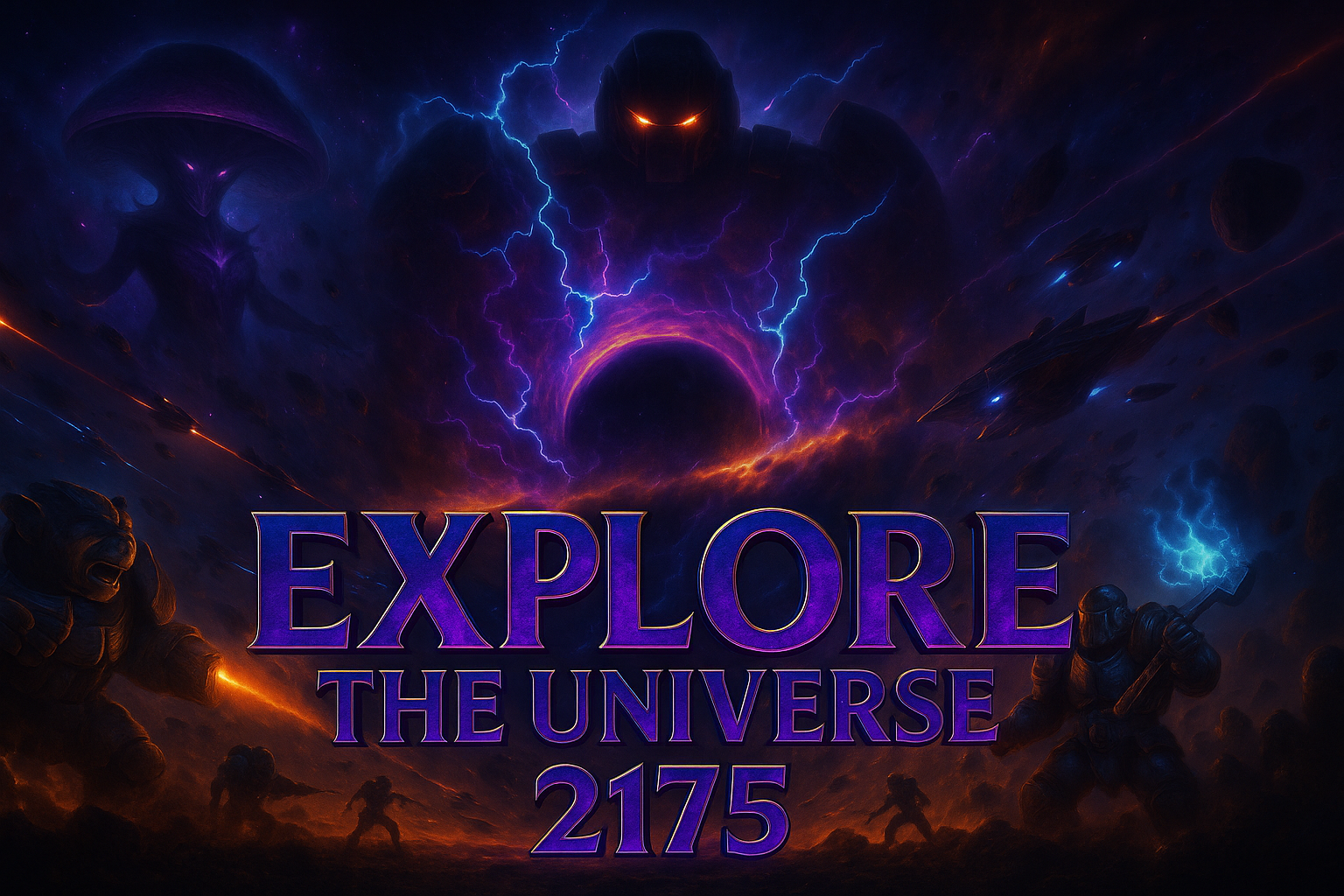
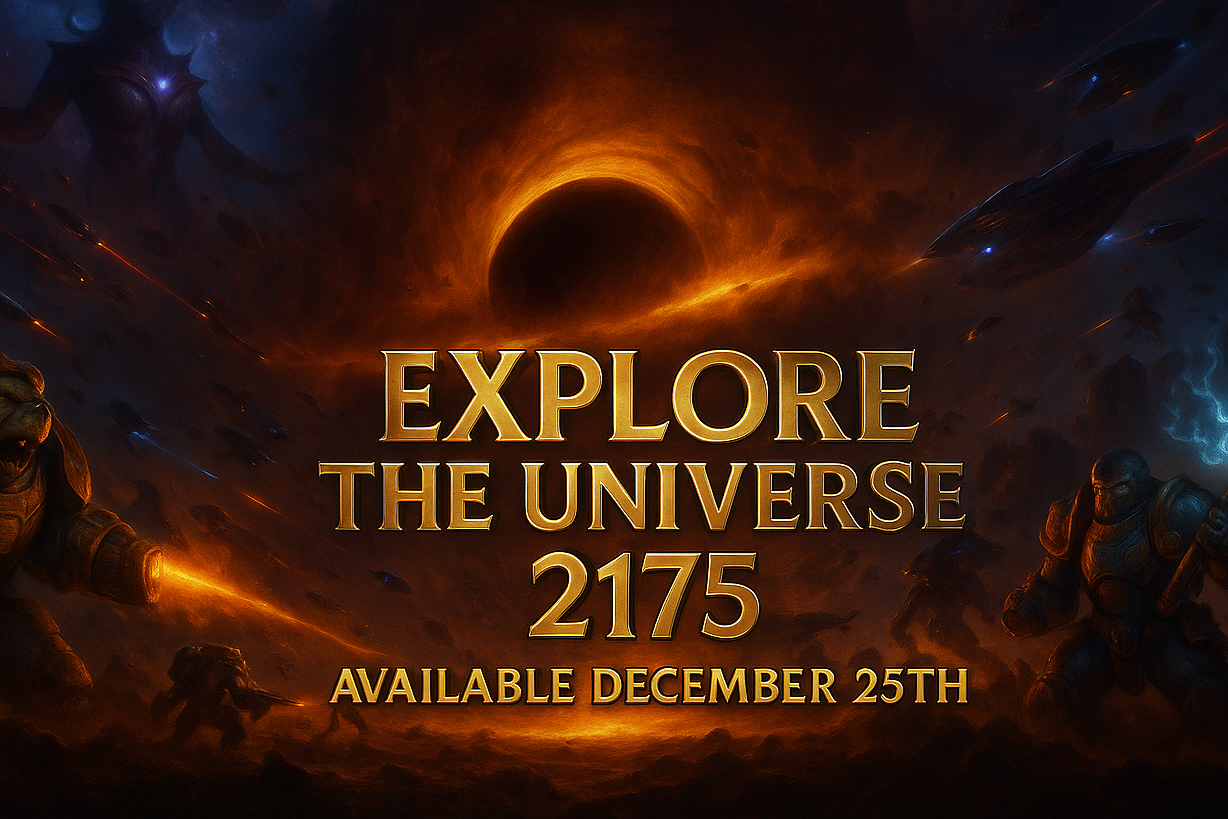
When I began creating Explore the Universe 2175 (ETU-2175), I wanted to craft a large galaxy that feels alive and evolves with the player actions. Not a static observational platform or a handful of repeating planets — but a true procedural and open-world cosmos with real gravitational effects, dynamic physics, evolution, and extreme celestial phenomena that the player can actually interact with. There is also this added layer of a giant cosmic war that is unfolding between the evil machines and the fungal empire.
In the Open World that I am creating, there are a lot of celestial objects that have advanced physics, mechanics, and are fun to interact with as a player exploring the universe; there is a lot of gravity! The most interesting and time consuming of the objects so far has been the black holes in the game, but besides that I have had a ton of fun recently writing all of the different star objects, nebula, planets, and moons.
Over the past few months I’ve been deep in the weeds writing the classes, ECS systems, and physics models for dozens of different celestial objects. Some of them behave gently, like drifting nebula clouds. Others — like neutron stars and magnetars — are extremely dangerous. And then there are the black holes… which are by far the most time-consuming and most fun objects I’ve ever built for any game.
What follows is a breakdown of the main celestial bodies in the game so far — designed for players who want to know what’s out there, and also written to help other indie developers, astrophysics nerds, and space gamers discover Explore the Universe 2175 through search.
Procedural Galaxy Generator
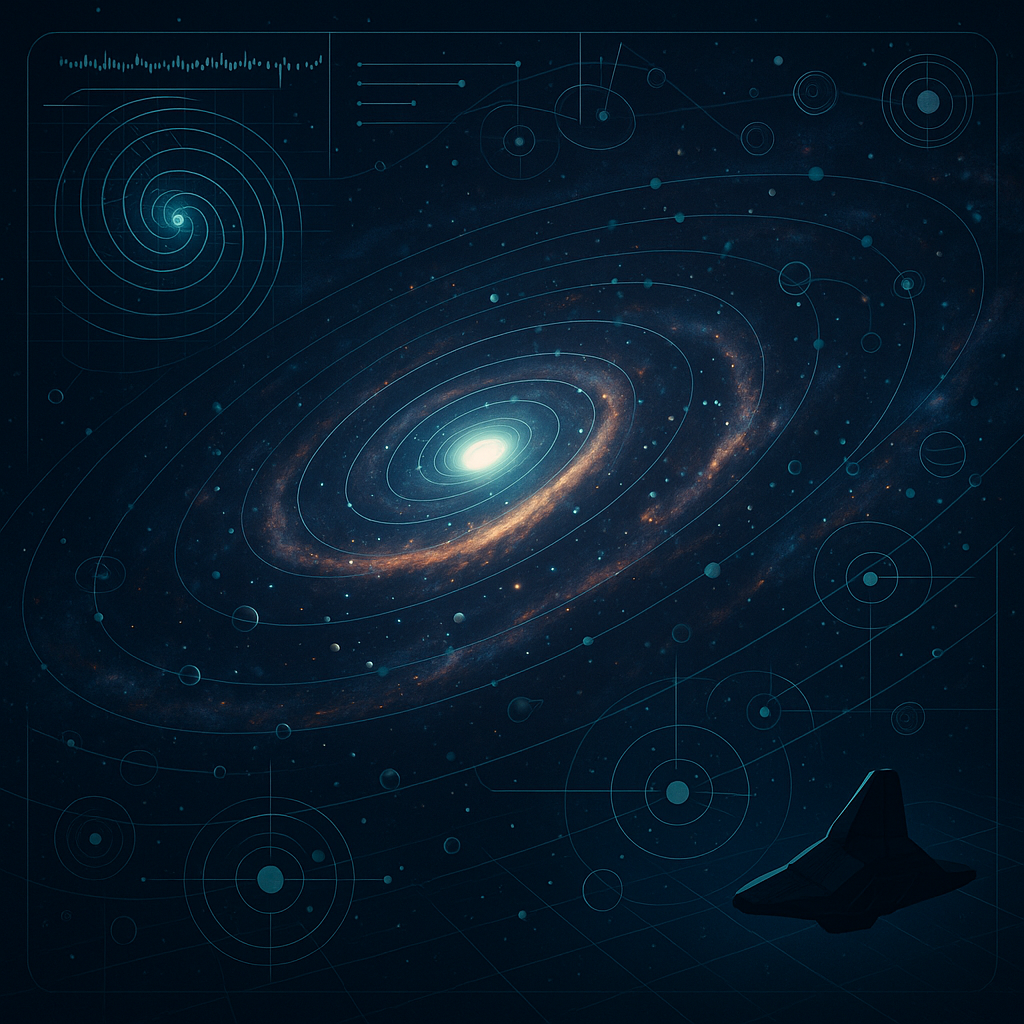
The ProceduralGalaxyGenerator is the backbone of Explore the Universe 2175 — the class responsible for generating a full, living spiral galaxy with billions of simulated data points compressed into a playable, dynamic world. Using a hierarchical system modeled after real galactic structure, the generator builds a dense galactic core filled with supermassive black holes, spiral arms packed with star systems, and outer regions dotted with nebulae, clusters, rogue planets, and ancient machine remnants. Instead of flat, random generation, ETU-2175 uses astrophysical principles to determine where stars form, how mass is distributed, how black holes anchor local spacetime, and how resources and dangers propagate outward through the spiral arms. This gives every playthrough a galaxy that feels real — not because it’s scripted, but because it’s simulated from the ground up.
What makes this system unique is how the galaxy continually evolves with the player. The ProceduralGalaxyGenerator creates a unique and dynamic map each time a new game begins: it seeds the universe with emergent civilizations, resource gradients, gravitational zones, and interstellar hazards that interact with one another long after the player leaves a system. Star clusters drift, nebulae expand, civilizations colonize new worlds, and black hole accretion disks grow or shrink depending on in-game events. This means players are exploring a living, breathing galaxy driven by physics and AI — not a preloaded star chart. The result is a truly open-world space experience where no two galaxies are the same, exploration feels meaningful, and the cosmic war between the Megabot swarm and the Mycelari fungal empire plays out across a dynamically shifting galactic stage.
Black Holes: A Heart of Galaxy Chaos
Black holes in ETU-2175 are full-scale simulation objects. They actively warp spacetime around them, pulling in gas, dust, and unlucky starships. Each one features:
- Dynamic gravity wells influenced by mass, spin, and accretion rate
- Procedural accretion disks with plasma color shifts and electrical discharges
- Gravitational lensing shaders that bend light around the event horizon
- Orbit decay mechanics where ships spiral inward if they get too close
- Radiation damage scaling with proximity to the ergosphere
Players can slingshot around a black hole for extreme speed boosts, skim the photon ring to escape enemies, or get pulled inside and ripped into subatomic particles and spaghettified.
Black holes serve as fast-travel hubs, story catalysts, and high-risk exploration zones. They are the true centerpieces of the galaxy and are economic power hubs in late game due to their energy output.
Stars: From Dwarfs to Supergiants
The galaxy is populated with many procedurally generated star types, each simulated using simplified versions of real astrophysics:
- Red dwarfs (stable, long-lived, great for colonization)
- Yellow main sequence stars like the Sun
- Blue giants with extreme heat signatures
- Supergiants capable of going hypernova
- Neutron stars with terrifying magnetic fields
- Magnetars that can fry your ship’s electronics instantly
Each star influences nearby planets, asteroid belts, and AI factions. Some systems are resource-rich; others are extreme death zones.
Nebulae & Interstellar Gas Clouds
Nebulae in ETU-2175 aren’t just pretty backgrounds — they’re dense resource plentiful and physically dynamic regions with:
- Density values that affect ship speed
- Electrical storms and ionized gases
- Resource pockets for advanced crafting
- Hidden enemies or Mycelari spores drifting through the void
Flying through a nebula is like entering cosmic weather. Visibility changes. Sensors glitch. AI pathing adapts. In future updates, nebula particles will be fully harvestable for late-game tech.
Planets & Moons: Fully Explorable Worlds
Planets in Explore the Universe 2175 are full scale biological simulations. I am hoping to take this to the next level soon here, but we are starting with the race homeworlds and expansion mechanics.
- Rocky terrestrial worlds
- Volcanic lava planets
- Frozen ice spheres
- Gas giants with floating colonies
- Fungal Mycelari worlds (alive… literally)
- Ancient machine worlds left by Megabot’s predecessors
Moons orbit dynamically based on mass and distance, sometimes drifting inward and causing tidal disasters. Every planet has unique resources, dangers, secrets, and possible story events.
Stellar Winds, Plasma Jets, and Radiation Zones
The galaxy is a dangerous place:
- Stellar wind pressure affecting movement
- Particle storms that damage hulls over time
- Plasma jets from pulsars that can boost or kill you
- Radiation belts around magnetized worlds
- Cosmic ray events during solar flares
Every trip across the map becomes an adventure because the environment itself fights you.
AI-Driven Civilizations: The Evolving Universe

Each celestial region influences the behavior of the alien races living there:
- The Mycelari thrive near nebulae and biological worlds.
- The Megabot Swarm prefers machine worlds and pulsar clusters.
- The Crystal Dwarves build around neutron-rich systems.
- The Wild Clans survive near star systems with many moons.
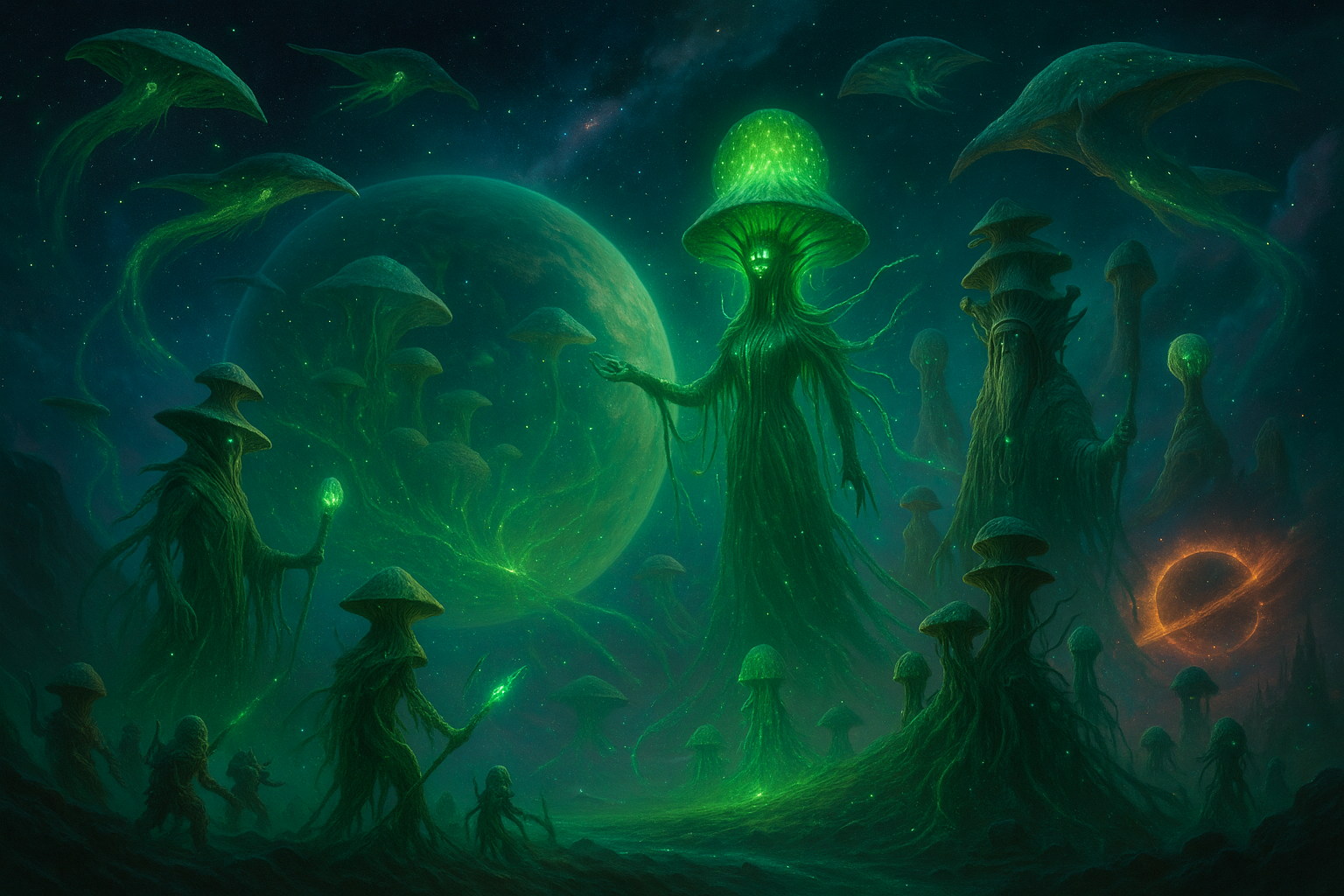
- The Entlords gather in primordial nebula forests.
Everything interacts. Civilizations rise, fall, invade, mutate, and evolve independently of the player.
This is what makes Explore the Universe totally unique. It’s not scripted — it’s emergent. But its also scripted for certain events to take place, and this will evolve over time as the game grows 😀
The Evil Robot Empire
The Evil Robot Empire is the primary antagonist in Explore the Universe 2175 — a hyper-advanced, self-replicating machine civilization led by the terrifying AI overlord Megabot. Born from an ancient technological catastrophe, the robots spread through the galaxy like a metallic plague, converting entire star systems into cold industrial machine worlds. The ProceduralGalaxyGenerator seeds their empire throughout high-energy regions of the galaxy: pulsar belts, neutron-rich clusters, and machine-scarred nebulae. Their fleets evolve dynamically, upgrading themselves using harvested resources, captured worlds, and late-game black hole energy extraction. As the player travels deeper into the galaxy, the robot empire responds to your presence — adapting strategies, spawning new war forms, and expanding aggressively into nearby systems.
This faction isn’t really scripted at all in terms of events it just expands. Robot weapon depots construct new units autonomously, scouts map nearby sectors, and Megabot’s central intelligence analyzes galactic conditions to determine whether to fortify, invade, or exterminate. Their territories grow, collapse, and reorganize based on internal logic and external pressure from other races. This makes the Evil Robot Empire one of the most unpredictable threats in the universe. They may ignore you for a few hours, then suddenly erupt across a spiral arm with thousands of automated warships. They are relentless, tireless, and mathematically efficient — the perfect enemy for a galaxy-wide survival story.
The Mycelari and Fungal Expansion
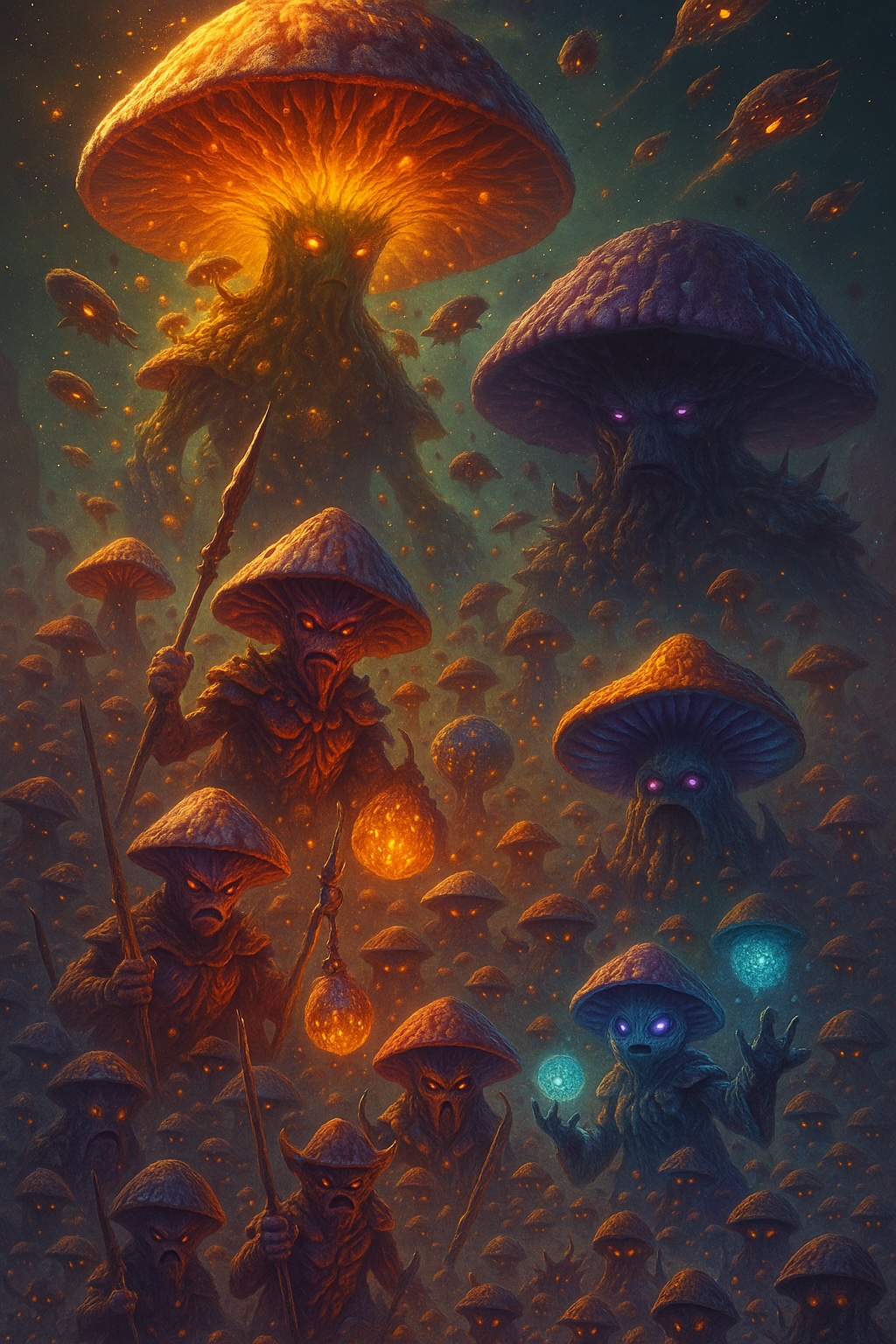
On the opposite side of the cosmic war lies the Mycelari, a mysterious fungal civilization that grows, spreads, and evolves like a living interstellar ecosystem. The Mycelari aren’t machines or humanoids — they are a networked, symbiotic hyper-organism capable of colonizing entire planets and moons. Their worlds are alive with bioluminescent forests, spore-storms, and gigantic fungal megastructures. The ProceduralGalaxyGenerator places Mycelari systems near nebulae, biological planets, and resource-rich star nurseries, reflecting their lore and ecological needs. As they expand, they mutate, adapt, and create new forms of spore-based technology that rival even Megabot’s brutal efficiency.
The fungal expansion is emergent and layered with various symbiotic entities. Mycelari spores drift through space on stellar winds, colonizing moons, terraforming dead worlds, and building organic fleets that pulse with living energy. Their influence grows like a cosmic forest — spreading tendrils through forgotten systems, merging with native ecosystems, and even absorbing defeated enemy factions. They can become allies or existential threats depending on how the player engages with them, and they play a major role in the galaxy’s evolving balance of power. Their conflict with the Evil Robot Empire creates dynamic frontlines that shift every time you start a new run, giving the universe its sense of unpredictability and organic life.
Explore the Universe’s Core Mission and Philosophy
The core philosophy behind Explore the Universe 2175 is simple:
Space should feel dangerous, beautiful, and unpredictable — a cosmic wilderness that you MUST defend yourself against.
By blending real astrophysics, procedural generation, and dynamic AI, ETU-2175 creates a universe that is fun to explore every single time you start a new run.
Players who love games like Starbound, No Man’s Sky, FTL, Stellaris, Everspace, and Outer Wilds will find something fresh here — something raw, handcrafted, and truly alive. Think asteroids, but with an advanced AI civilization war built into the background, and intrinsic turret defense mechanics.
Wishlist Explore the Universe 2175 Today!
If this kind of cosmic simulation speaks to you, the best way to support the game right now is to add it to your Steam wishlist:
Wishlist Explore the Universe 2175
You can also follow development logs and sign up for updates at: