
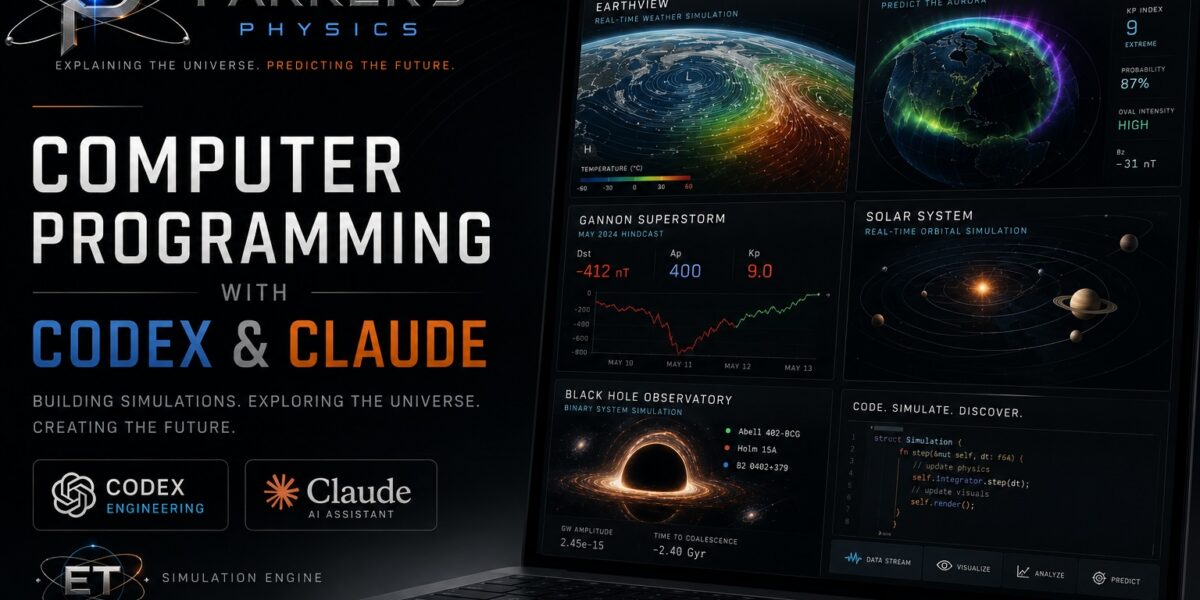
Artificial intelligence has fundamentally changed the way I write software. But I still use text-edit a lot, too.
During the past year I’ve been using Codex, Claude, Cursor, Grok, Gemini, and the other AI agents to help build two ambitious long-term projects:
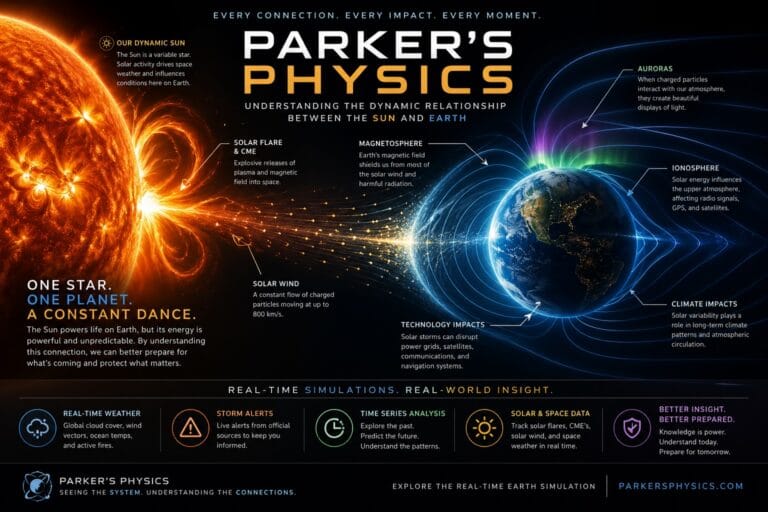
Parkers Physics, a growing collection of interactive scientific simulations.
Explore the Universe 2175, my upcoming space strategy and exploration game.
Rather than replacing programming, these tools have allowed me to iterate faster, explore larger ideas, and spend more time solving scientific and engineering problems instead of repetitive coding tasks.
Outside of software, life has also been busy. I recently earned my California C-27 Landscape Contractor’s License, which gives me the flexibility to run my landscaping business during the day while dedicating evenings to programming, writing, music, and yoga.
That balance has turned out to be one of the best decisions I’ve made.
The Evolution of Parkers Physics
Parkers Physics is the biggest effort in my line-up next to Explore the Universe 2175, which is a constantly progressing thing. The game will be coming out February 2nd and the Demo is close! Probably within a month, definitely within 2. I have a very high standard for performance so I will be continuing to work out the kinks well into 2027 and I am ready for that.
Parker’s Physics will the the quiet companion of the game that fuels a lot of the mystery and intrigue of the Explore the Universe 2175 open world. There are a lot of celestial objects in the Parkers Physics App that are mirrored in the game, but obviously they are both geared towards similar things, space, the cosmos, black holes, but they both are good way to grow in different direction, Explore the Universe is 2D while Parker’s Physics is almost exclusively 3D.
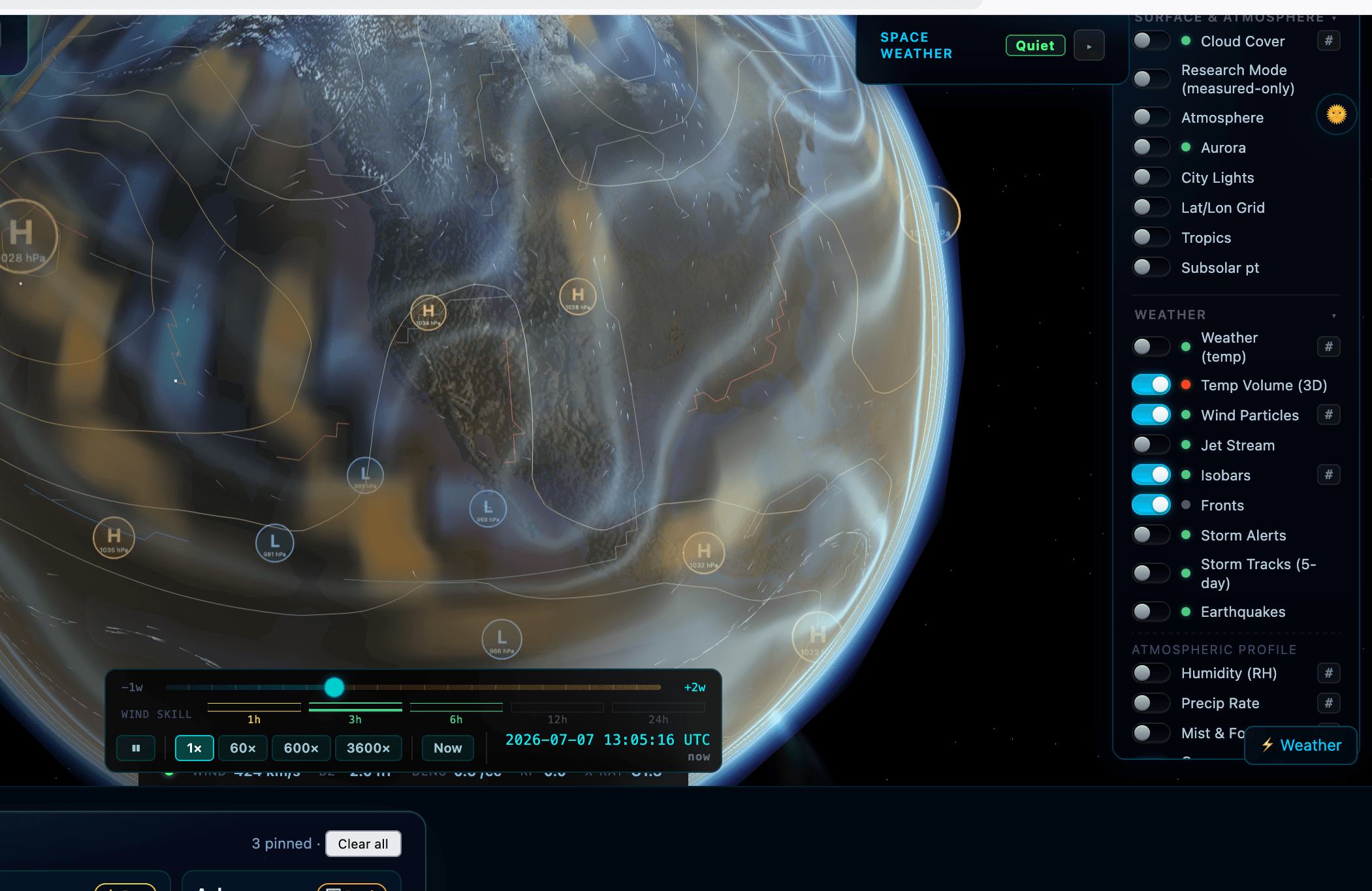
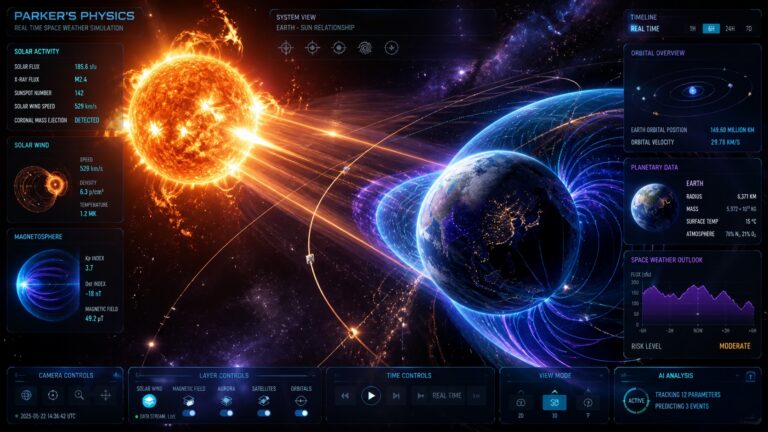
EarthView – a Parkers Physics Real-Time Earth Weather Simulation
As I continue to build Parkers Physics with Cursor, GitHub, Claude, and Vercel, I am finding that there are certain clusters that appear in terms of where the knowledge coagulates and what is fun to push forward in terms of the simulation science. I think its pretty obvious that these A.I. systems are going to enable simulations and just generally computer programming that fits into the general category of what AGI is, which lets just call it super-intelligence. Its pretty cool to explore the weather of planet Earth in real-time! Please keep in mind that this is under production, and I am doing my best to sort through the bugs, but mostly its just a lack of development at this point, it takes a lot of time to build this stuff, even with AI!
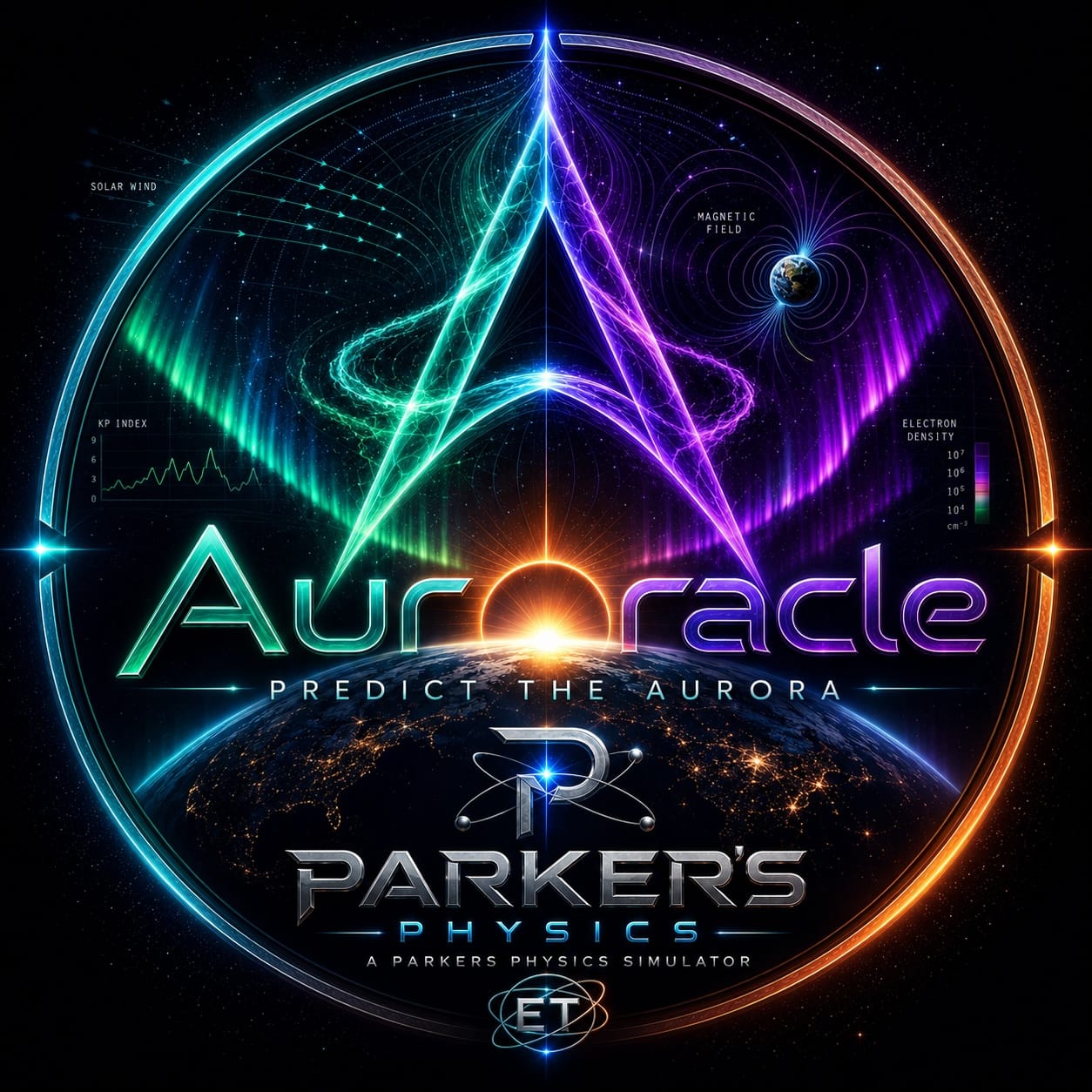
AurOracle – Predict the Aurora of Planet Earth
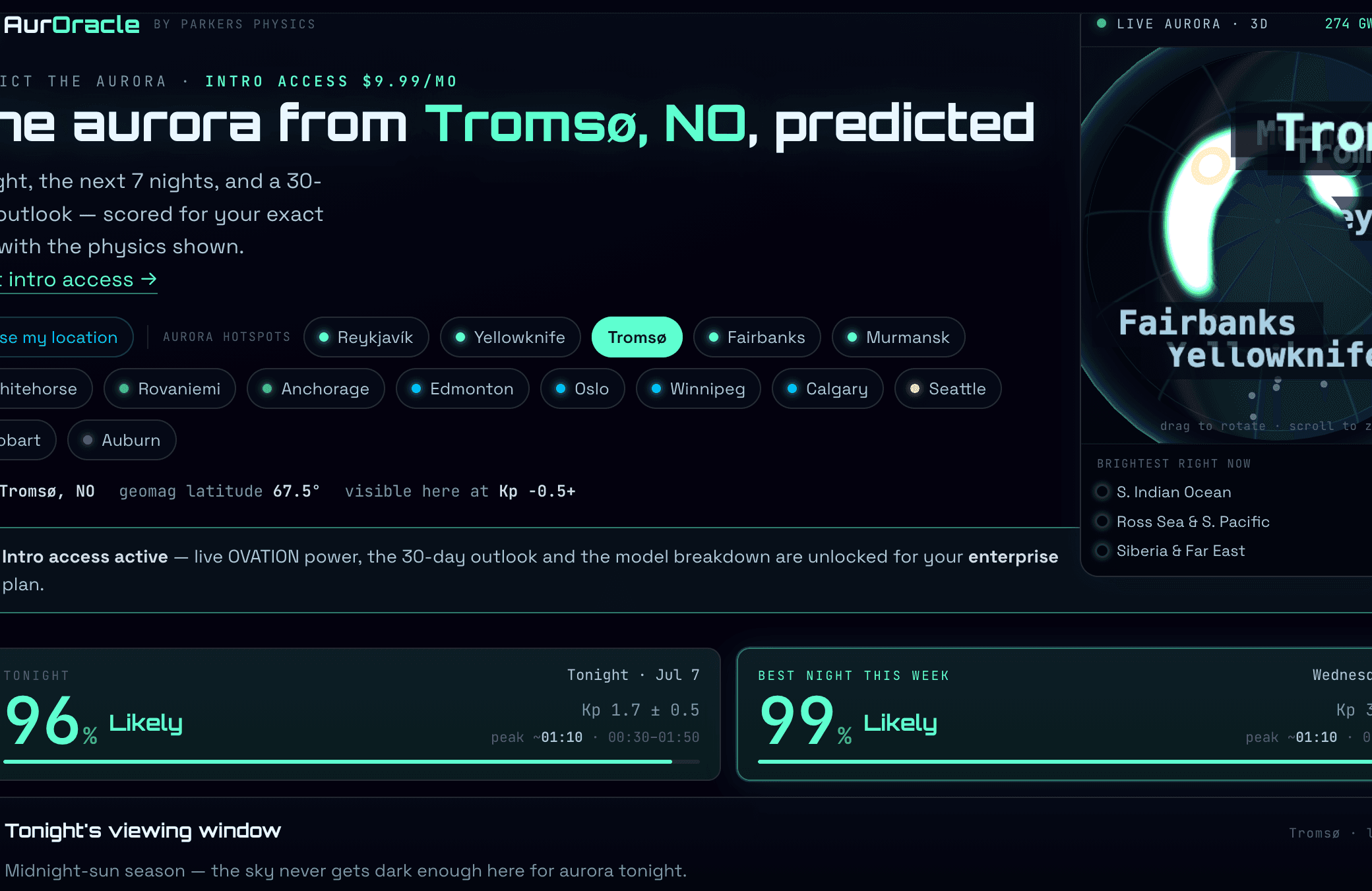
I made the AurOracle for photographers, travelers, astronomers, and anyone hoping to experience the Northern Lights. The Aurora is much further north than where I live in Auburn CA, but it became clear that users might want to have something like this if they wanted to see a strong aura, say if a solar storm hit.
I have been watching the app for a while and its clear that this year’s activity has been pretty heavy, the sun has been very active. This lines up with the solar maxima cycle, so we will likely have a lot of aurora activity heading into the new year.
There are certain areas of the planet that experience the auoras more intensely and its mostly in Northern Europe, Alaska, and Canada. Users can input their locations to see the likelihood of the aurora and strength rating on how strong it might be. I am continuing to build out the predictive analytics for intro users, so you could plan a trip around the northern lights. Its in progress, along with some other simulations that I am actively working on. Also expect the aurora mapping to get better, more 3D, and the UI to improve a bunch. I have a lot of UI/UX work to do right now.
Planetary System in Real-Time Positioning of our Solar System
About two years ago, whilst I was in Australia visiting my dear sister and her family, I got a chance to do a bunch of research on the outer planets, specifically Saturn and Uranus and Neptune. Jupiter is also on the list and honestly these objects are so fascinating that it is pretty easy to get completely lost in their research. Each is at least ten times the size of Earth, at the minimum and they all have lots of moons and interesting gravitational environments, not to mention atmospheres, volcanoes, ice deserts, and the whole idea of a ring (which is a temporary thing apparently) make the outer planets a lab that allows us to better understand Earth.
So I have brought in some cool screenshots from the simulations, these are in progress still.
Jupiter Planetary System
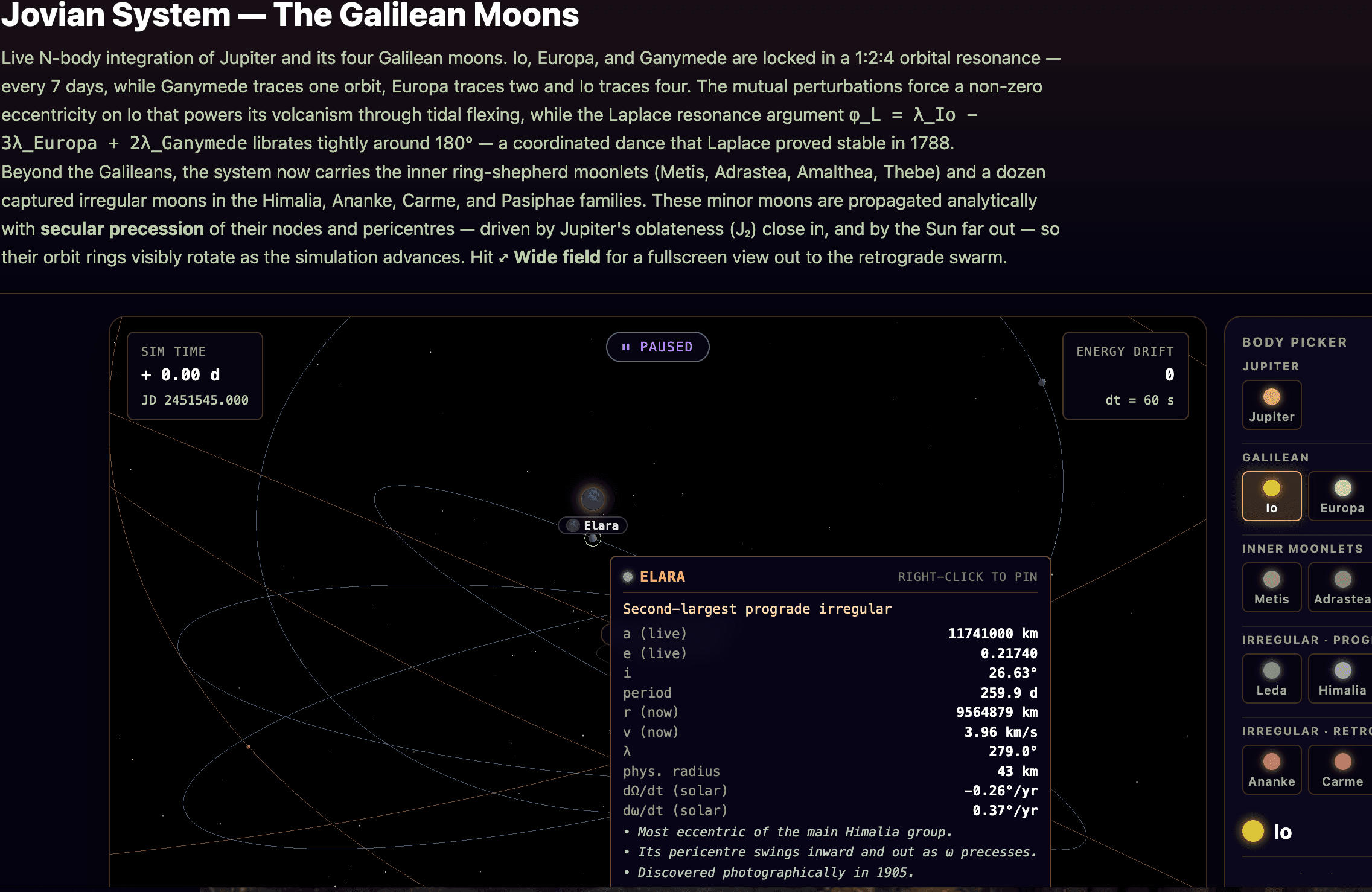
You can see how interesting the orbital systems of each moon are, imagine the precession of each object being simulated! It could be the next step.
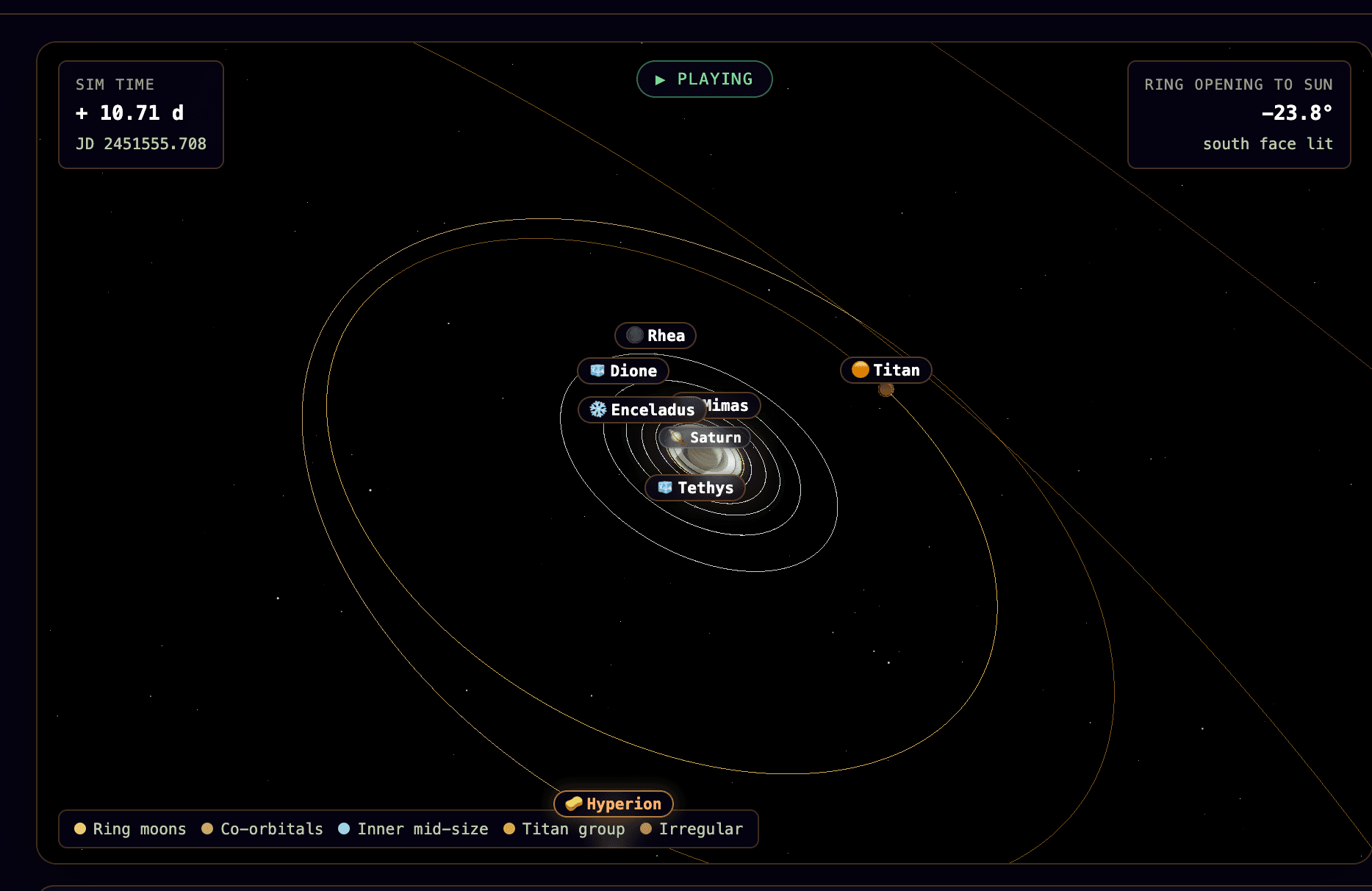
Saturn Planetary System
The dynamics of Saturn’s Ring are pretty interesting. I am hoping to turn this sim specifically into something more N Body oriented.
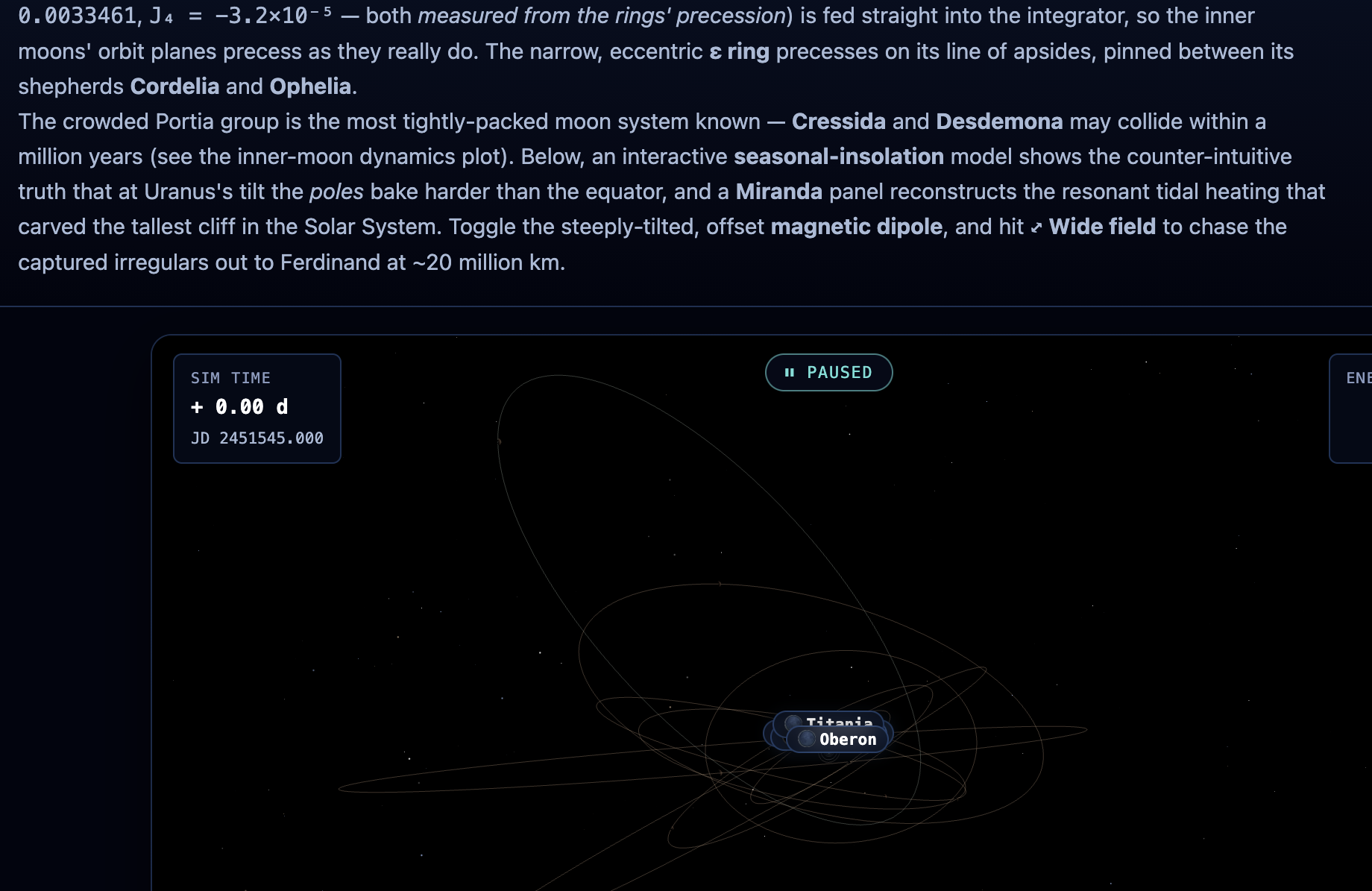
Uranus Planetary System
Neptune Planetary System
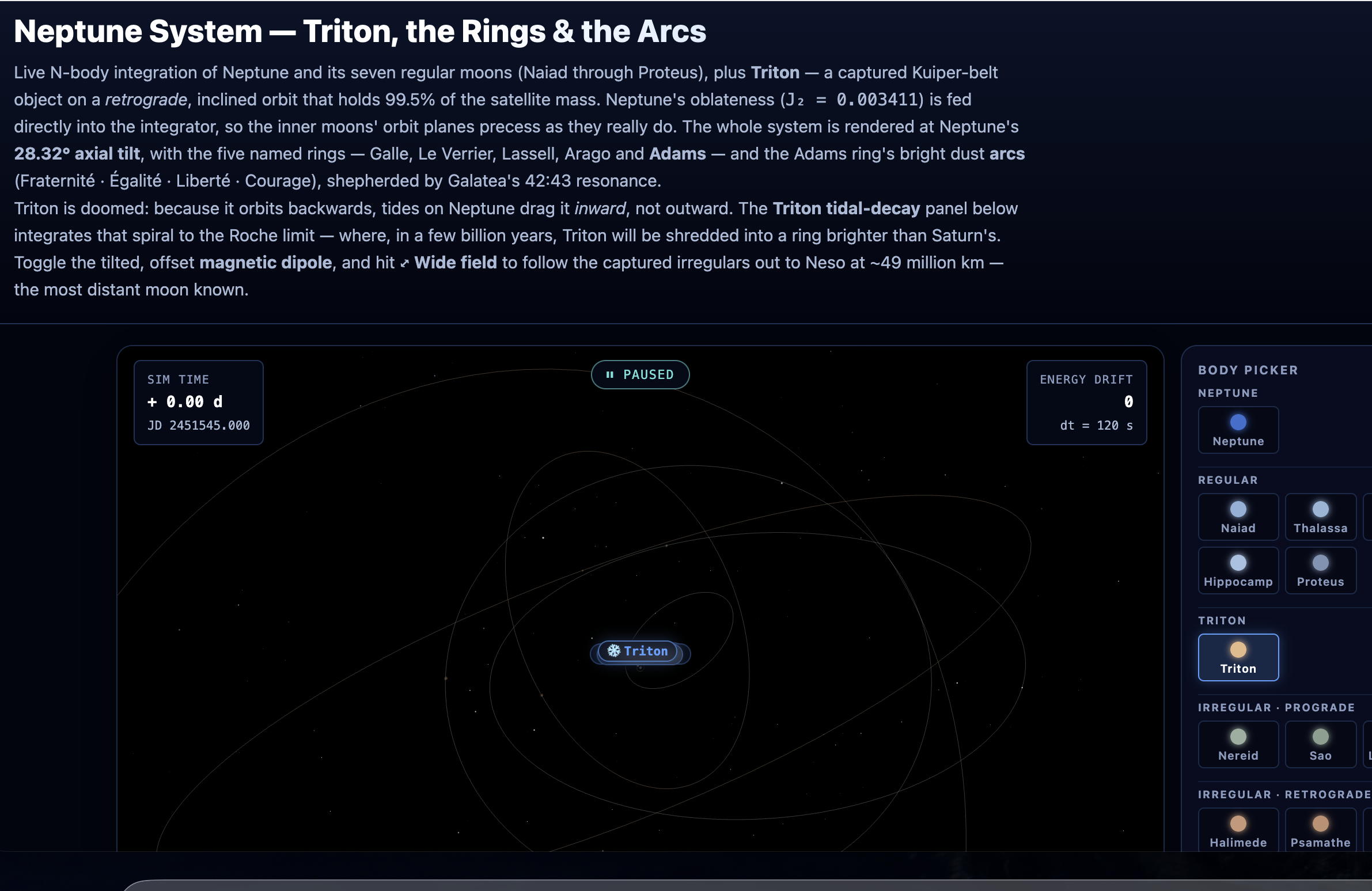
Live N-body integration of Neptune and its seven regular moons (Naiad through Proteus), plus Triton
Re-Creating the Gannon Superstorm
The Solar Storm with an Index that lied to everyone. – Parkers Physics
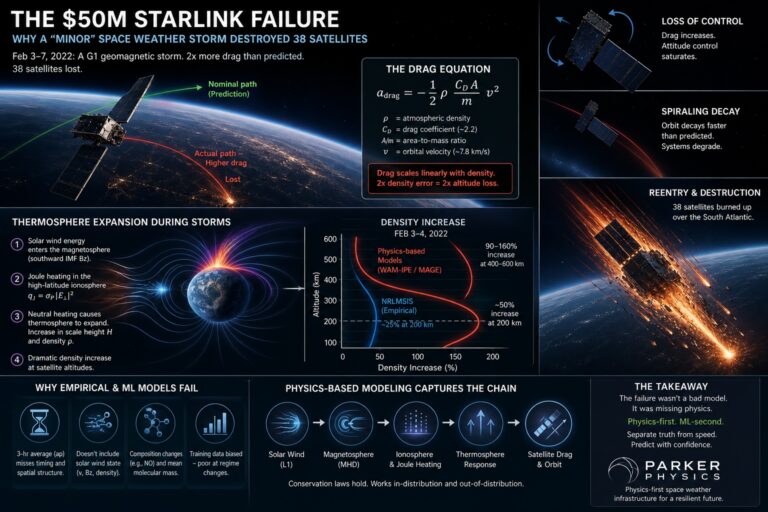
Ap (indexed measurement for ionospheric disturbance) has a ceiling. The scale tops out at 400, a design decision inherited from the 1930s Kp network. For roughly 24 hours during the Gannon storm, Ap sat pinned at exactly 400 — not because the magnetosphere stopped getting more disturbed, but because the ruler ran out of markings. Every Ap-driven density model (NRLMSIS included) was flying blind above the clamp, and the drag forecasts derived from them inherited the lie.
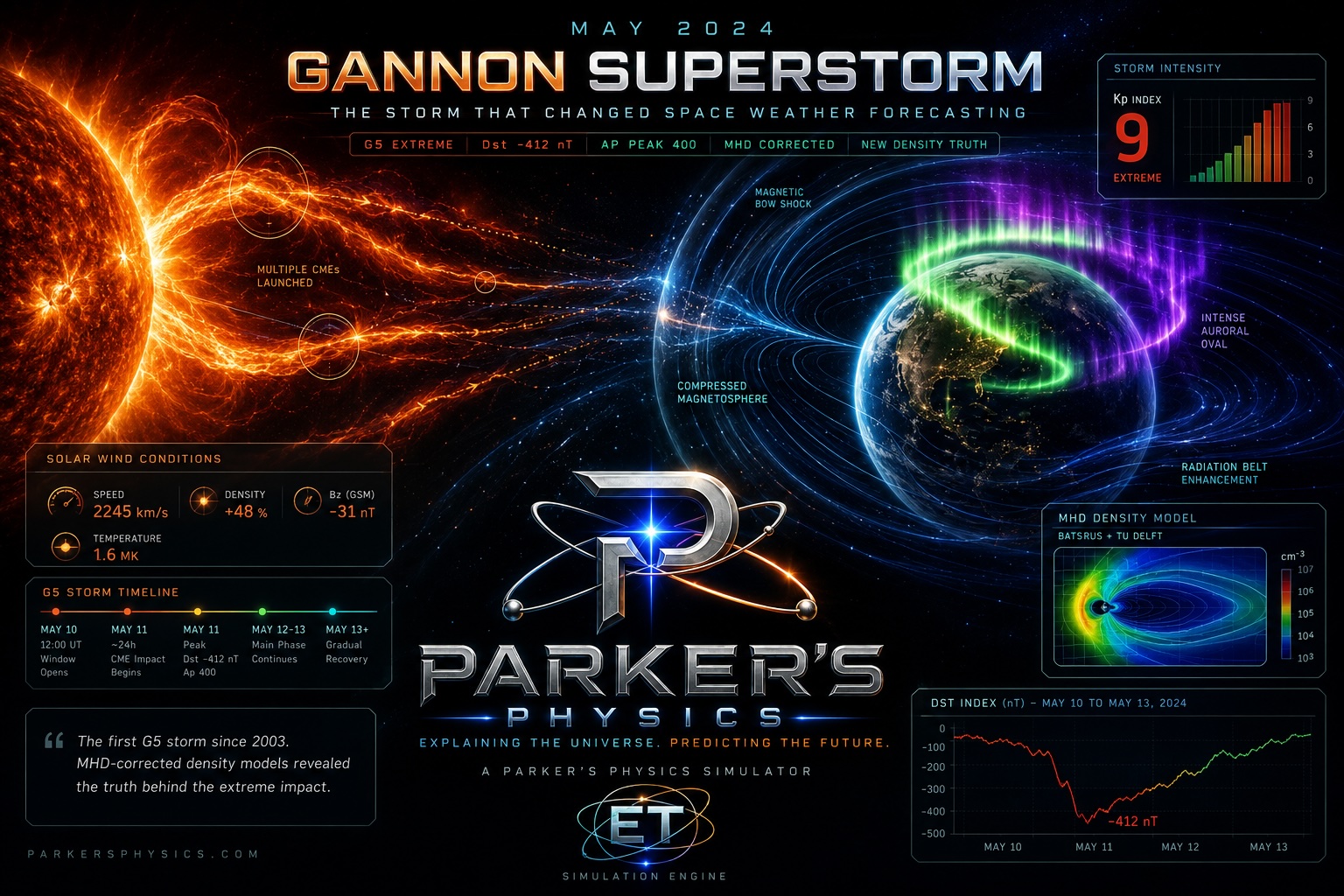
So we are starting to move into predictive analytics for solar disturbances, as well as trying to tie in the ionosphere to Earth weather in some kind of accumulator, but no real luck on the predictive front yet. Visual systems are for sure improving though.
The Hindcast Simulation took over two days in total run time, but the data is great! I think the new event analytics helps a lot with understanding how these storms work and why the indexes will feel off in certain situations. It allows us to better understand the measurements! The basic idea is to simulate the conditions of the storm so we can understand, based on the data, what is actually happening out there because we are learning that these indexes do not contain a lot of the information that satellite operators actually need.
So in reviewing the data, its a good idea to try to understand how the variables relate to each other. what AP is (its a rolling index of activity)
Why Ap Saturates
The Ap index is derived from the Kp index, which was designed nearly a century ago. Because Kp has an upper limit, Ap also has a maximum value of 400. During extreme geomagnetic storms like the May 2024 Gannon Superstorm, Earth’s magnetic disturbance continued to intensify even though Ap remained fixed at 400, effectively hiding the true severity of the event.
Why Dst Matters
Unlike Ap, the Dst (Disturbance Storm Time) index measures the strength of Earth’s ring current by tracking changes in the planet’s magnetic field. During major storms, Dst continues to decrease as the storm intensifies, making it one of the best indicators of the storm’s actual magnitude. The Gannon Superstorm reached approximately Dst −412 nT, clearly showing that conditions were far more extreme than Ap alone suggested.
Why Density Models Failed
Many operational thermospheric density models use Ap as a primary driver for estimating atmospheric heating and satellite drag. Once Ap reached its maximum value of 400, those models effectively stopped receiving stronger storm input, even though the upper atmosphere continued to expand. As a result, many models underestimated thermospheric density and satellite drag during the most intense phase of the storm.
Why Hindcasting Is Useful
A hindcast reconstructs an event using observations that became available after it occurred. By replaying the Gannon Superstorm with improved magnetic, satellite, and atmospheric measurements, Parker’s Physics can estimate how the thermosphere actually evolved rather than how operational models predicted it in real time. This helps identify where existing forecasting methods break down and provides a foundation for developing more accurate space weather prediction models.
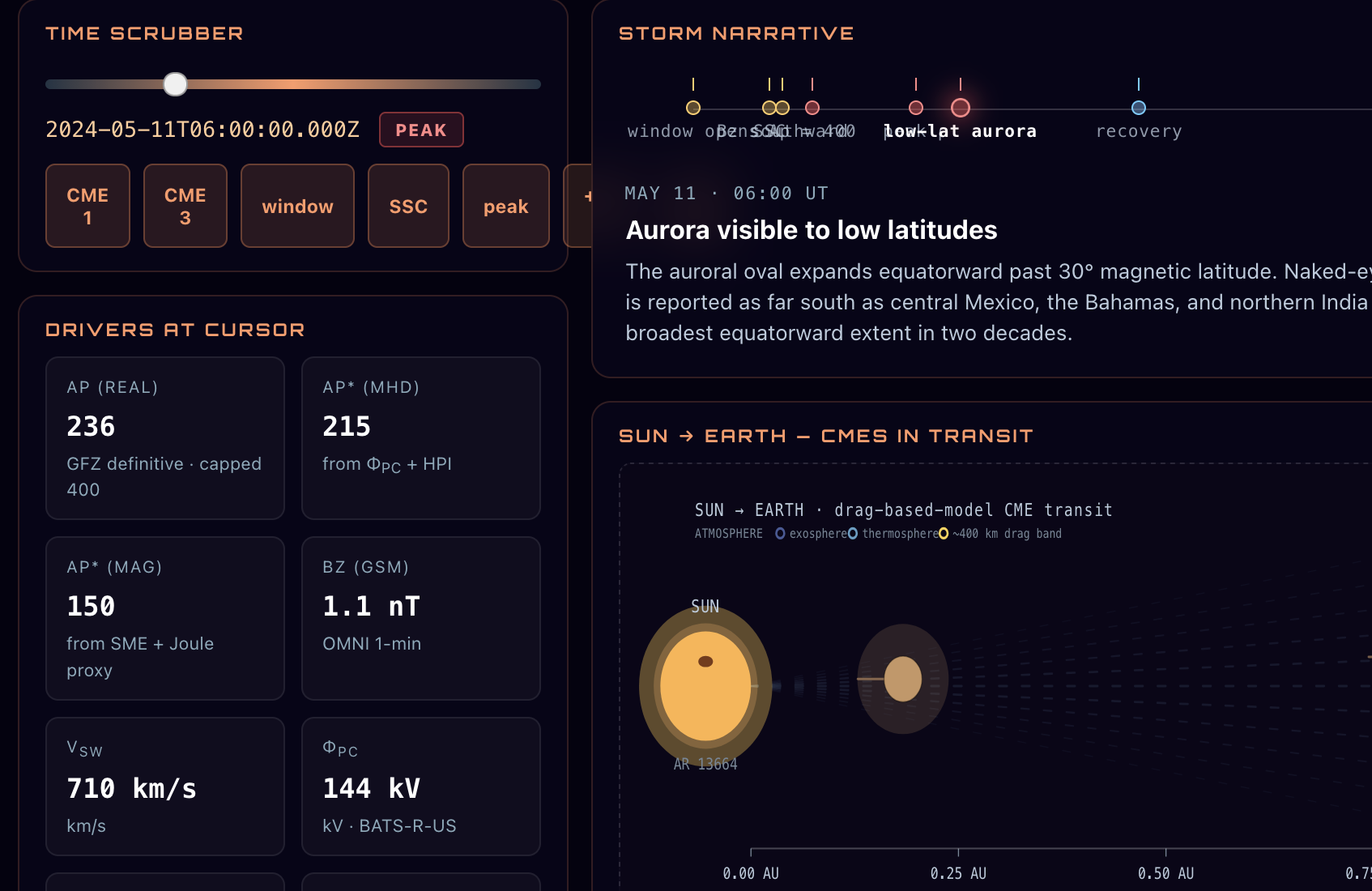
Give the time scrubber some play, look at the numbers and the developments of the CMEs, how they work. I will be working more on the visuals as well.
Black Hole Observatory
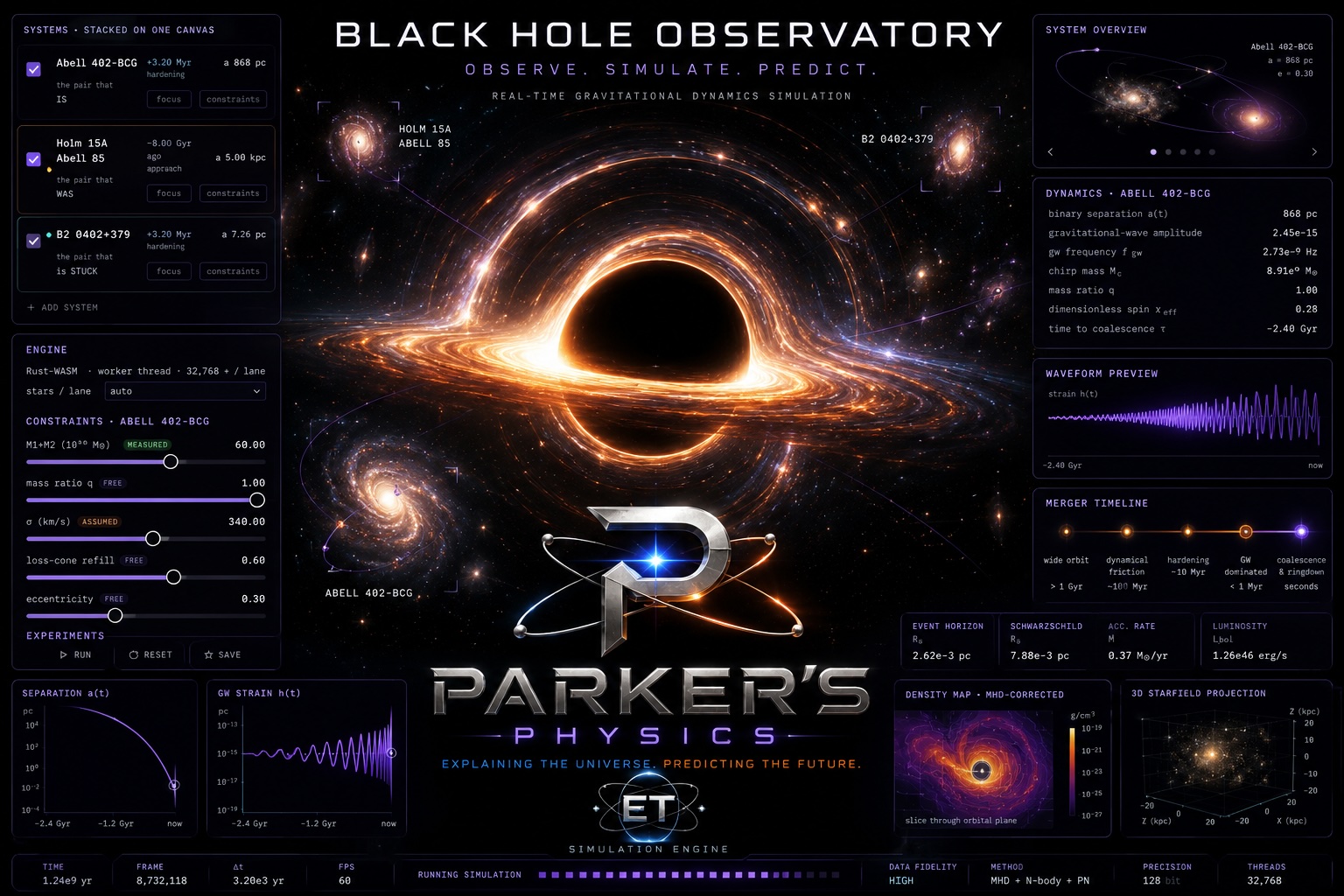
This is another part of the app that I started working on yesterday, but I am going pretty hard into it, so it should develop pretty quickly. I want to basically use this to figure out how the black hole objects behave, to try to get some sprectrum of all of the different one. The thing is that when you are simulating a black hole, it is generally accompanied by a galaxy! And a galaxy is a lot to simulate, trust me that’s how Explore the Universe 2175 started, the procedural galaxy simulator. So anyhow look forward to the first few objects in that series and right now its very much in progress and broken, so try not to be judgemental about it. I have a ways to go with developing it, but its live, so i thought I’d share.
Continuing Development on Explore the Universe 2175
Explore the Universe 2175 is a constant work for me, I am still developing it every day, mostly working on the collision systems for various units and new weapons, and abilities! Fungal Warriors and Mecha Scouts have recently gotten a big upgrade, and it will be fun to show off all of the new mechanics in a new trailer. Its in the works.
Today my workflow looks something like this:
Codex / Cursor
- backend engineering
- architecture
- Rust
- Python
- UI/UX
- Prototyping
Claude / GitHub
- WebDev
- UI
- Prototyping
- simulation planning
- scientific reasoning
ChatGPT
- image generation
- brainstorming
- article editing
- marketing
Each tool has strengths, and learning when to use each one has become a valuable programming skill in itself.
I’ll be writing an article on this as soon as this most recent performance bug gets dealt with. I generally am using codex for back-end engineering now, Fable mostly for Parkers Physics and prototype development. Its obvious Chat GPT got an image generation upgrade recently, but Claude’s abilities to multitask and also do long horizon deep research is very impressive. Finally Fable is back, so I was able to finish a lot of the new physics work thanks to that. Cheers!