

Interactive Galaxy Map: Exploring the Universe with Parker’s Physics
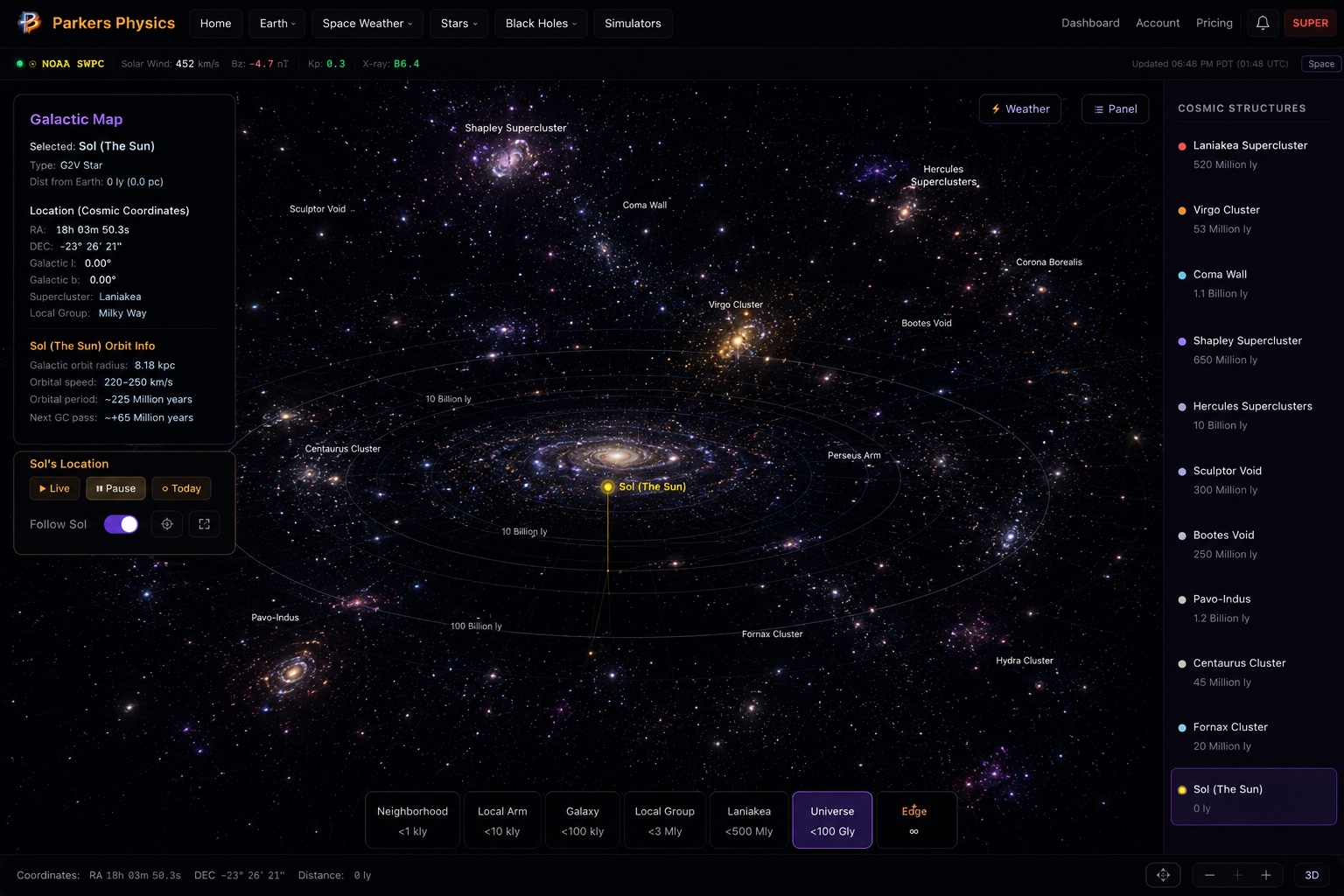
Parker’s Physics features a real-time interactive universe map that allows you to explore stars, black holes, nebulae, and galactic structures across the observable cosmos! This is the first time I’ve ever seen the locations of the stars and black holes and nebula and such visualized in this way, so I definitely want to share it so you can check it out!
👉 Explore the live simulation at Parker’s Physics.com

The current build includes:
- Interactive galaxy visualization
- Black hole simulations
- Real-time object navigation
- Procedural galactic structures
- Experimental astrophysics rendering systems
This is the Galaxy as we know it today!
Coordinate Systems, Maps, and Planets
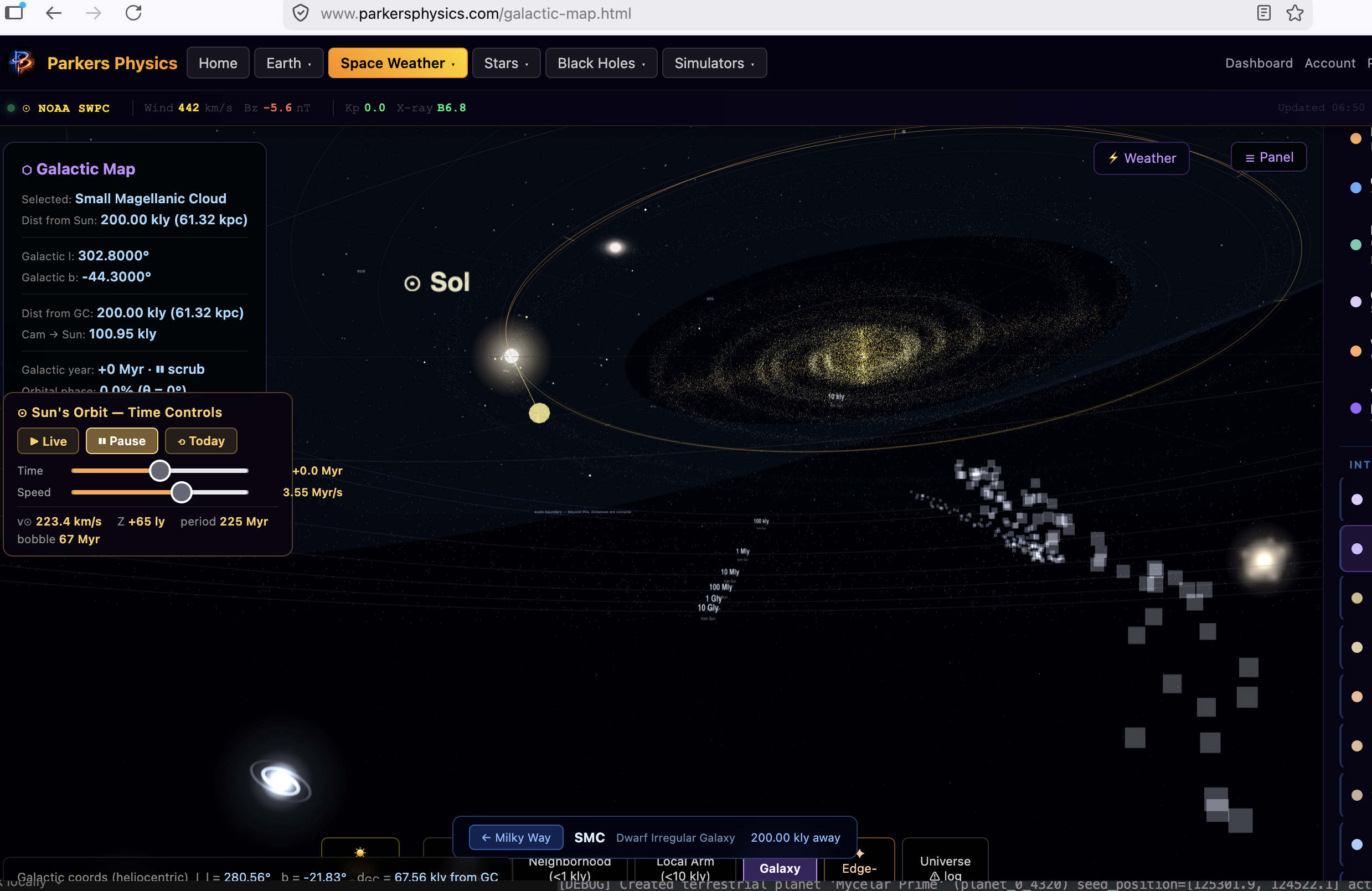
I had this idea way back when to plot the sun’s course in the Milky way, and this simulation is a continuation of that thought process. In Explore the Universe 2175, two of the most important chunks of code are the Procedural Galaxy Generator and the World Map. In each new game, a procedural galaxy is spawned with about 10,000 objects, they are placed into the 1,000,000 x 1,000,000 unit worldspace in a random galactic formation including Several different kinds of Black Holes, Stars, Planets, Moons, and other kinds of objects.
Understanding Astronomical Coordinate Systems
I guess this just makes sense intuitively to me now, but there was a bit of a phase where I had to learn about of the different kinds of coordinates that are used to describe stuff in space.
There are Many Different Kinds of Coordinate Systems
Common Mathematical Coordinate Systems
Cartesian Coordinate System: Uses perpendicular axes (x, y) in 2D, or (x, y, z) in 3D to define positions relative to a fixed origin (0,0).
Polar Coordinate System: A 2D system based on distance (r) from a central pole and an angle (theta ) from a reference direction.
Cylindrical Coordinate System: A 3D extension of polar coordinates, adding a vertical distance (z) to the (theta) polar coordinates.
Spherical Coordinate System: Defines a 3D point using a radial distance (rho) and two angles (theta) and (phi), often used for navigation and astronomy.
Specialized Coordinate Systems
Astronomical Coordinate System: A spherical system tailored for mapping celestial bodies (e.g., equatorial, horizontal).
Homogeneous Coordinate System: Used in computer graphics and projective geometry to simplify calculations (e.g., transforming 3D graphics).
Local Coordinate System: An arbitrary system with a custom origin (0,0) used for small-scale mapping or surveying.
Galaxy Map of Parker’s Physics
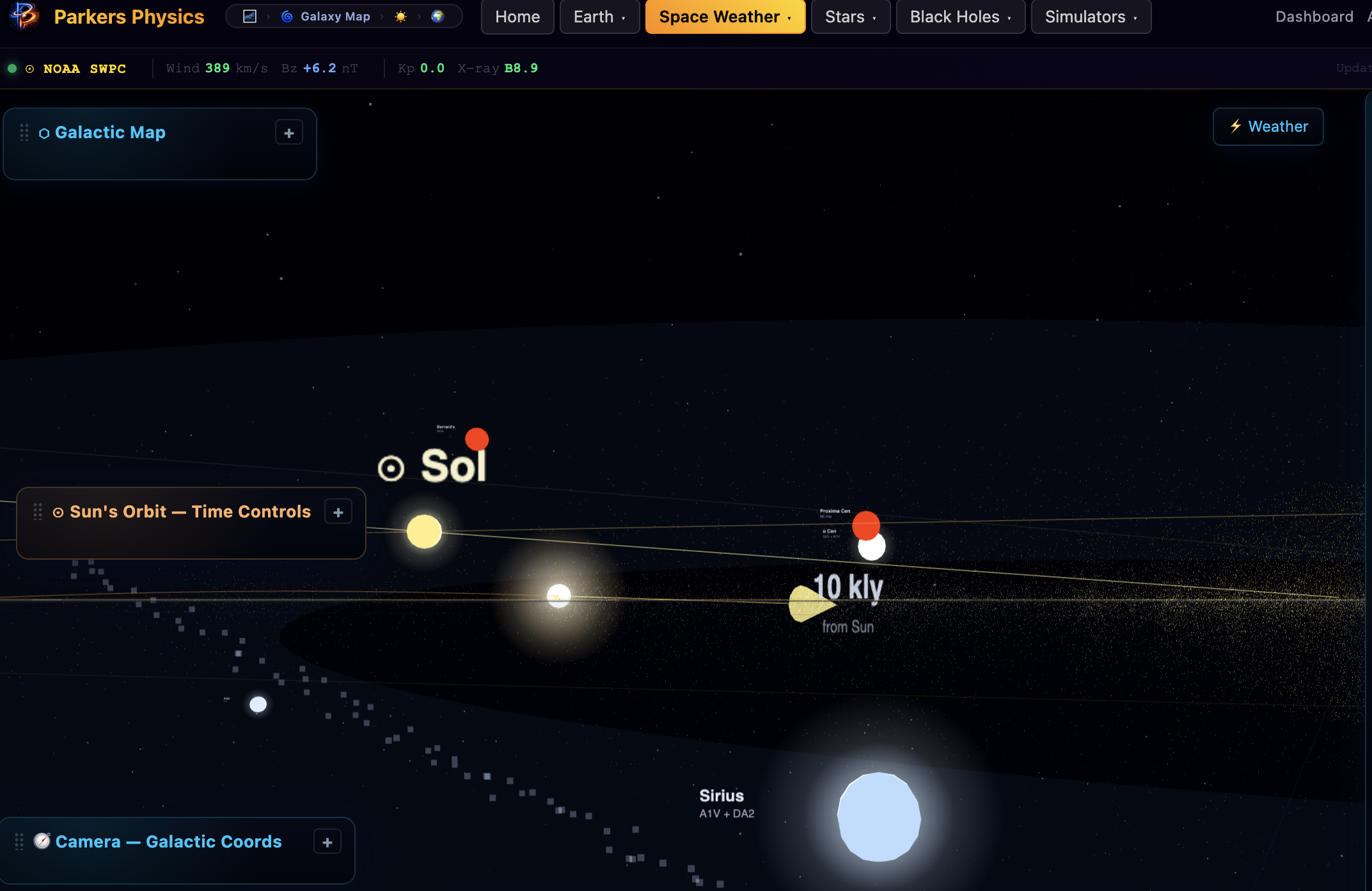
The Sun’s trajectory is visible yet a bit blown out of proportion so that you can see it in the app. The camera is fully functional, and will zoom in on objects as you select them with the mouse, or the panel to the right. of the screen. I am still working on the UI, so if you have any feedback, feel free to leave it at the feedback page
Building a Mobile-Friendly Interactive Galaxy Map
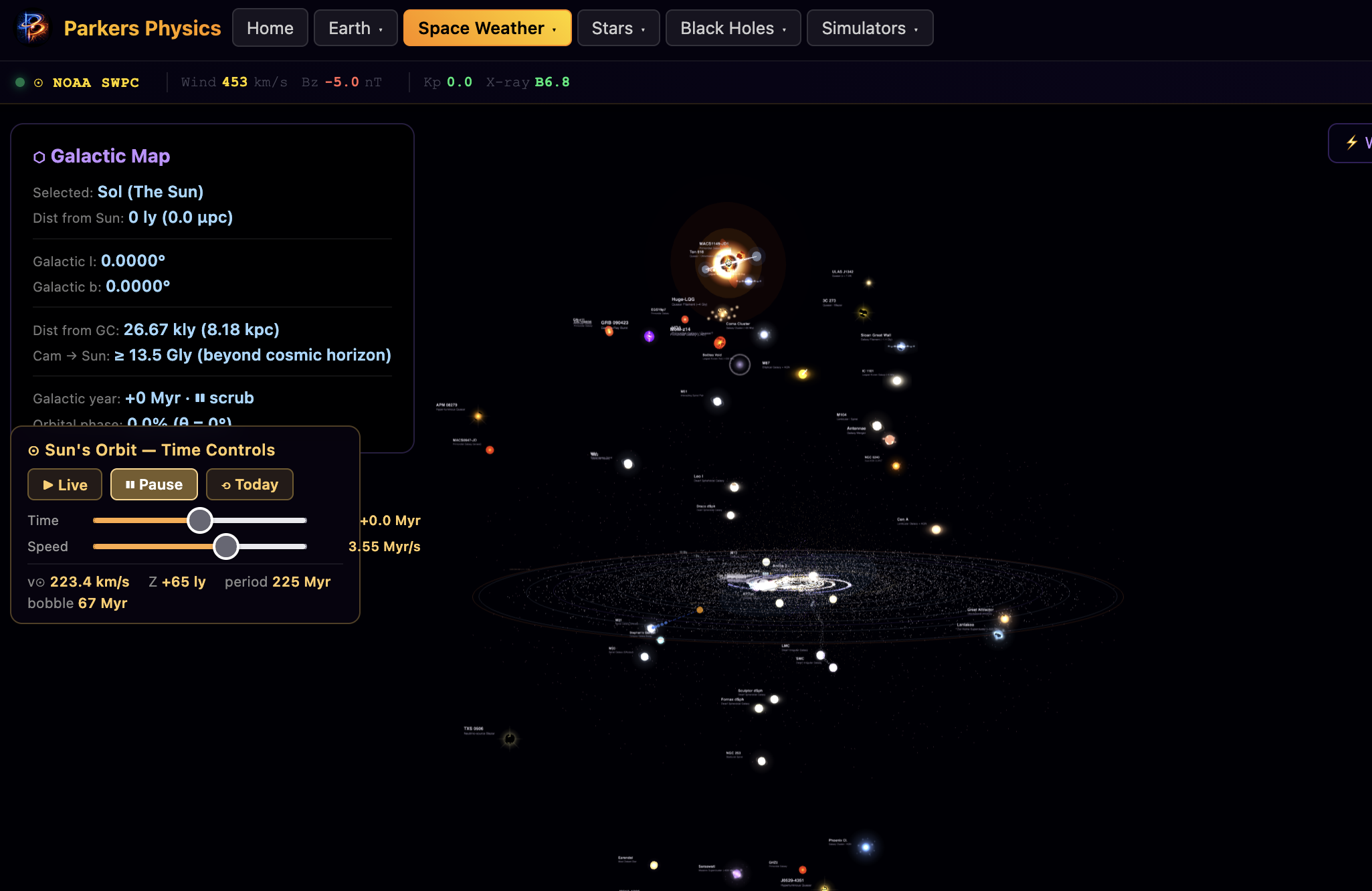
Obviously making the whole app mobile friendly is an endeavor, but I do think that it is necessary to truly make it fun to explore the various regions in space to have responsiveness and different quality tiers for graphics, user machine optimization, etc. AI makes all of that much easier.
Several objects have been fascinating to chart, such as the largest known black hole, Ton 618, and the largest known super cluster, the Phoenix Star Cluster. The local system is fascinating, and that is where the biggest distance/size bugs are in the visual interface. Still a WIP, as we continue to explore the stars, it should improve drastically.
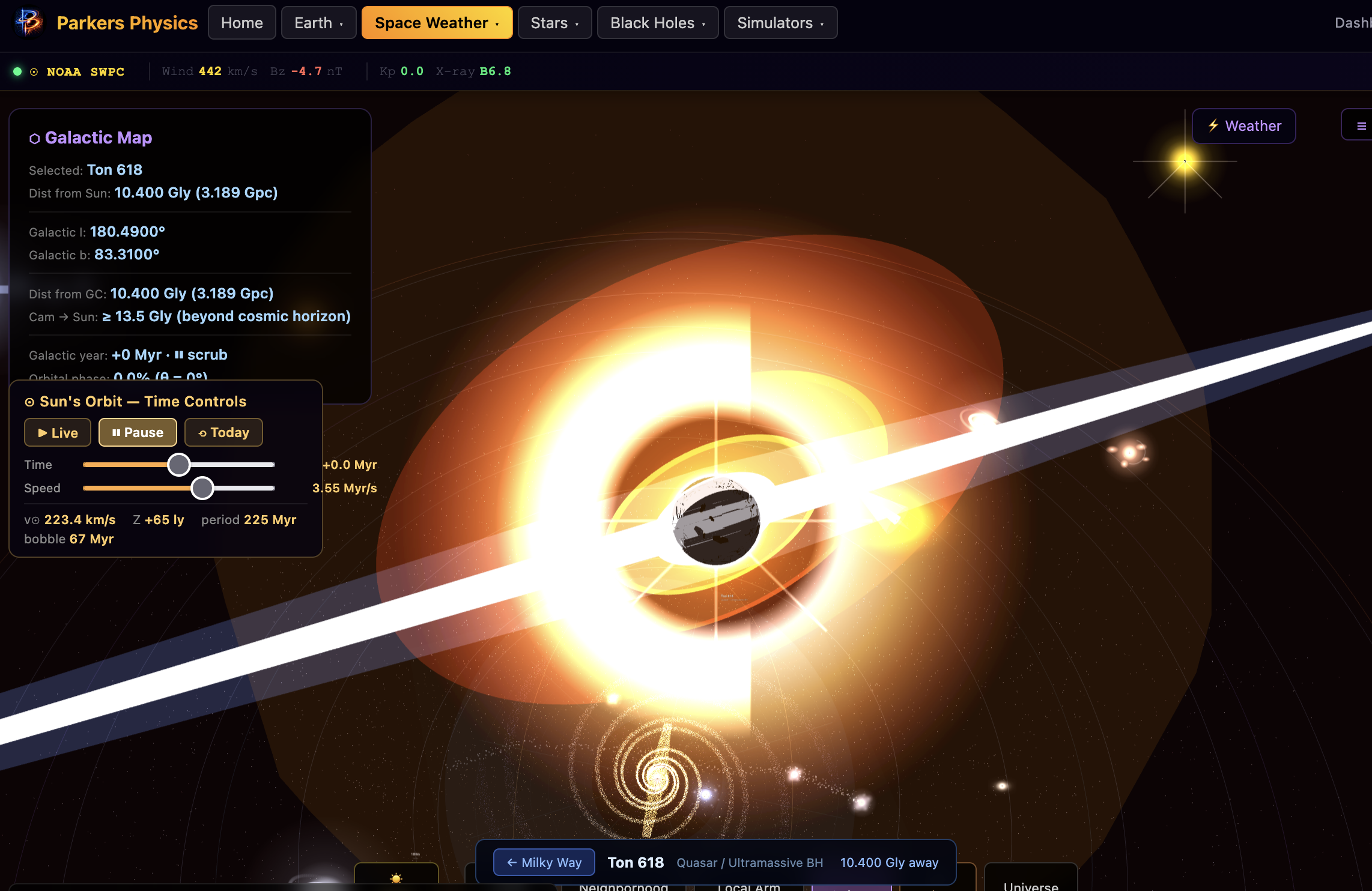
Research Grade Ton 618 Simulations
Ton 618 has been an object of study for me throughout the past couple of years of my astrophysical research. Its incredibly dynamic, and this simulation needs a lot of work, but I haven’t seen a better one on the web. Its worth toying around with, even if the camera isn’t quite finished yet.
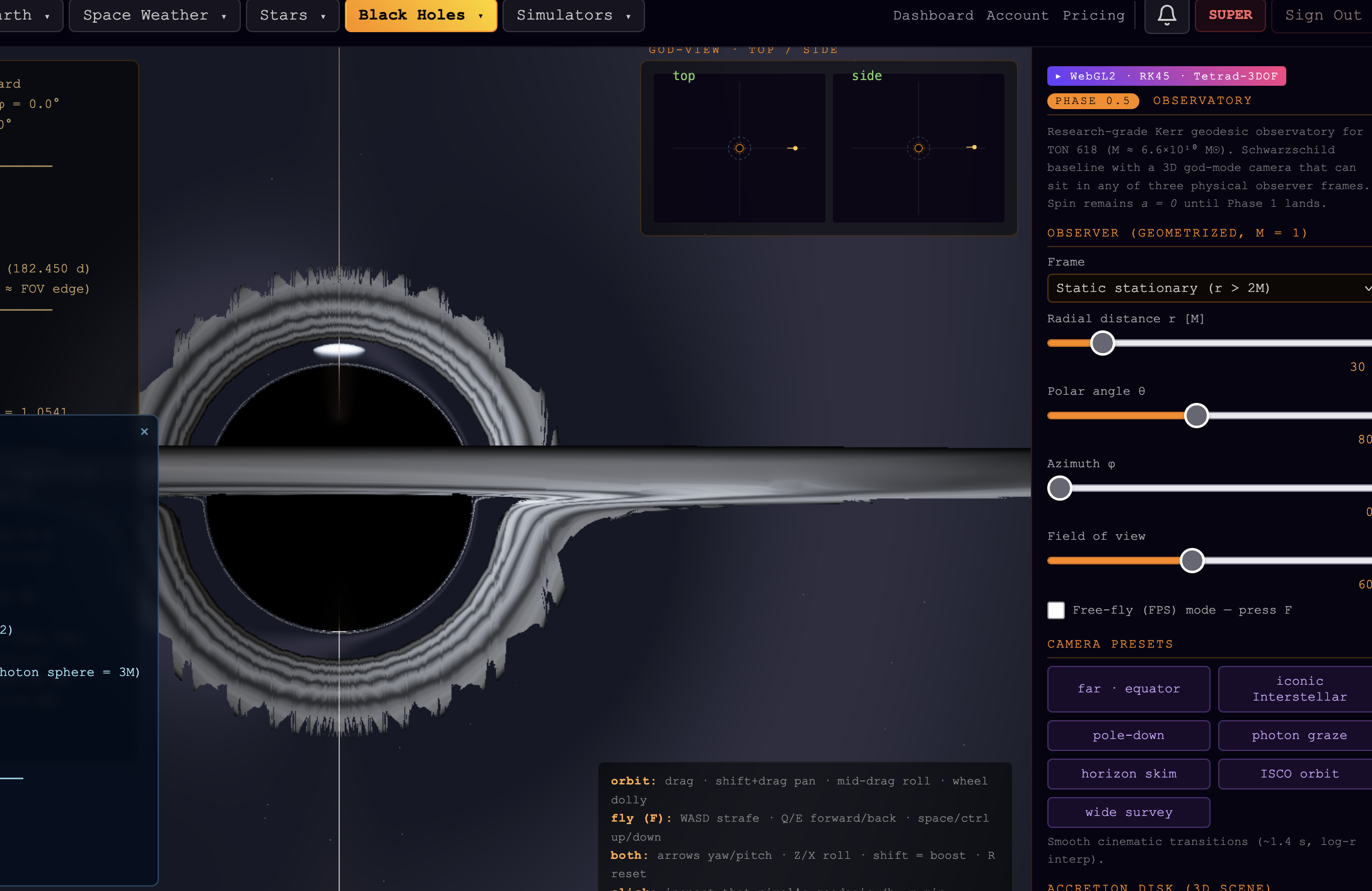
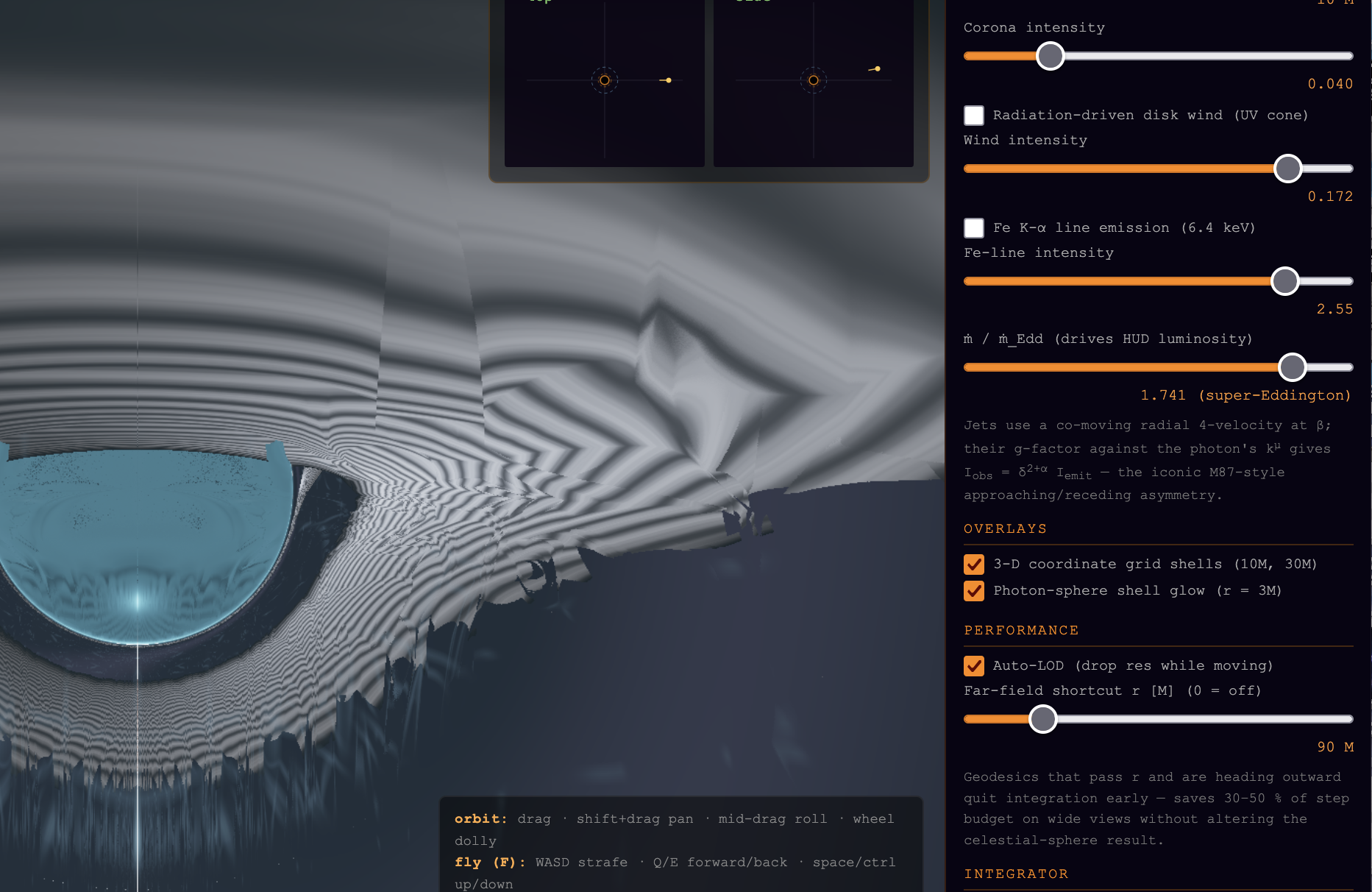
Try the various preset camera views and adjust the UI elements to the right of the simulation to explore the geometry of a black hole. Soon I am hoping to add the Lyman Alpha Blob that Ton618 is famous for.
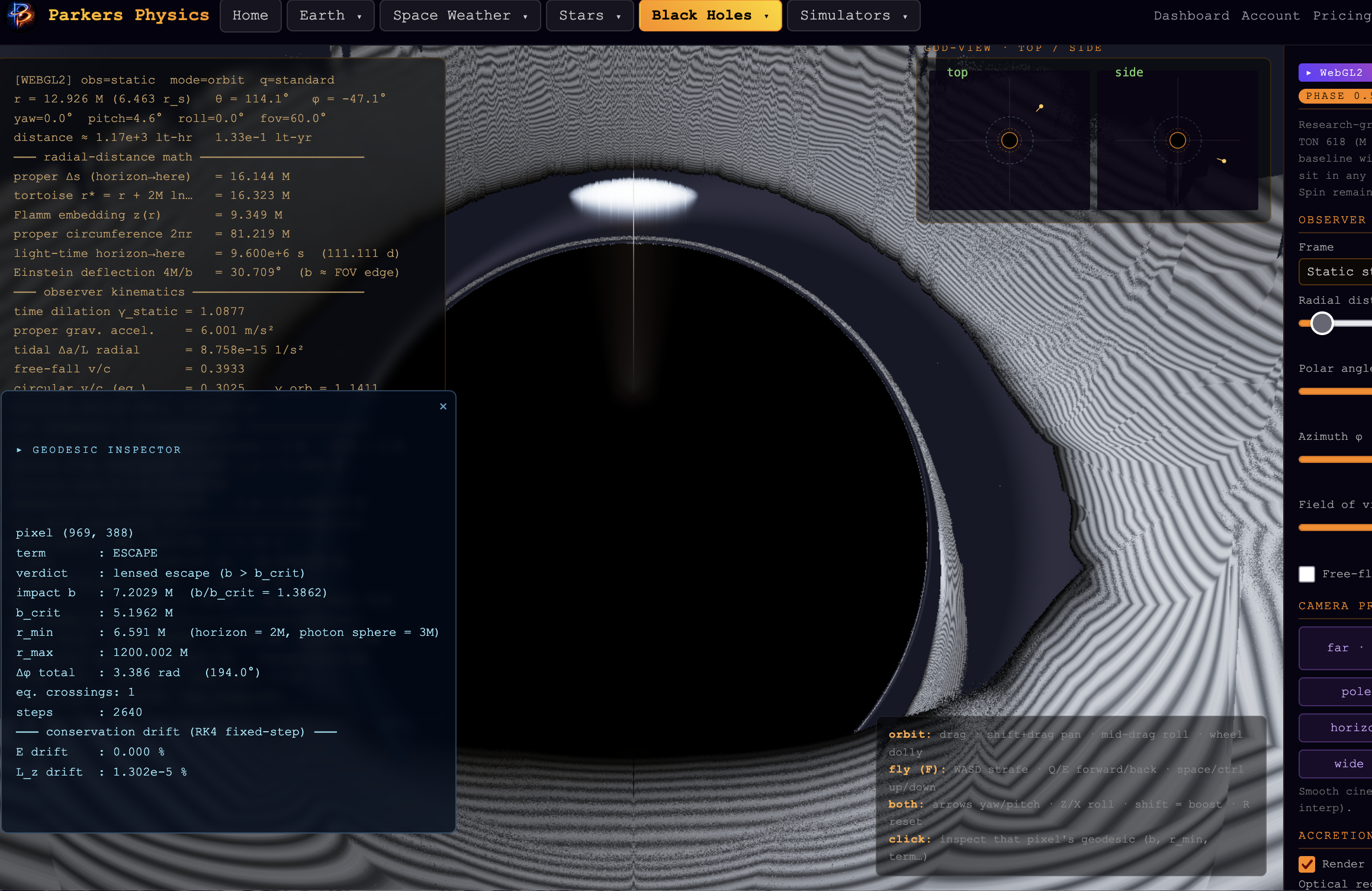
Ton 618 Black Hole Simulation and Visualization
TON 618 deserves its own article and will get on shortly, but I wanted to show off the visuals.
FAQ
What is Parker’s Physics?
Parker’s Physics is a real-time astrophysics visualization and simulation platform focused on space weather, galaxy mapping, orbital mechanics, and black hole simulations.
What is the live universe map?
The live universe map is an interactive galaxy simulation that visualizes stars, nebulae, black holes, and galactic structures using astronomical coordinate systems and procedural rendering techniques.
What is Ton 618?
TON 618 is one of the largest known black holes in the observable universe and is currently being visualized experimentally in Parker’s Physics.
Is Parker’s Physics scientifically accurate?
The project combines real astronomical datasets with procedural simulation systems and experimental rendering techniques. Some visual scales are exaggerated for usability and exploration.
The Future of Real-Time Universe Simulation
The current simulation is still heavily in development, but the long-term goal is to create a scalable real-time astrophysics exploration platform capable of visualizing everything from nearby planetary systems to galactic superstructures.
Future updates will include:
- Improved galaxy scaling
- Better object distance rendering
- Enhanced UI systems
- Mobile optimization
- Lyman-alpha blob visualization around Ton 618
- Expanded black hole physics systems
- Real-time stellar datasets
As the simulation evolves, Parker’s Physics aims to become both an educational astrophysics platform and a foundation for larger procedural universe systems connected to Explore the Universe 2175.
Related Articles
Explore More Astrophysics Simulations and Research
If you enjoyed the live universe map and galaxy simulation in Parker’s Physics, you may also enjoy these related articles and projects from ElliottElford.com:
Parker’s Physics and Space Weather Research
- Introducing Parker’s Physics
- Unveiling the Solar Wind Dynamics
- Tracking the Sun’s Trajectory Around Sagittarius A
- The S2 Star and Sagittarius A Orbital Simulation
- The Sirius System: A Bright Neighbor
Black Hole Simulations and Accretion Physics
- Black Holes 101: The Ultimate Guide
- Accretion Disk Physics
- Beyond the Horizon: Exploring Black Holes, Accretion Disks, and Plasma Physics
- Simulating a Black Hole
Explore the Universe 2175 Development
- The Galaxy in Explore the Universe 2175
- The Physics and Feel of Explore the Universe 2175
- Creating Realistic Space Flight Simulations in Explore the Universe 2175
- Explore the Universe 2175 Gameplay Trailer
AI, Simulation, and Scientific Visualization
- Modeling the Behaviors of Hydrogen
- Saturn, Orbital Physics, and the Birth of the Solar System
- Neptune: The Nautical Sailor Planet at the Edge of the Solar System
HelioChronicles and Solar Research
👉 Follow the development of Parker’s Physics and Explore the Universe 2175 for more real-time astrophysics simulations, black hole visualizations, and procedural galaxy research.